
Ear Shaping
How to Keep a Baby’s Ears From Sticking Out — Early Parent Guide
Learn how to keep a baby’s ears from sticking out: what temporary projection means, why DIY tape is limited, and when newborn ear molding is considered.
Parents searching how to keep baby’s ears from sticking out want a practical plan before school age surgery talk. In newborns, projection can relate to cartilage angle or conchal depth and may be assessable for early molding.
Short answer: Avoid tight DIY taping. Document the angle with photos, ask your pediatrician, and seek early specialist review if ears clearly project. Physician molding in the soft-cartilage window is the structured non-surgical option when the exam fits; surgery discussions belong much later if needed.
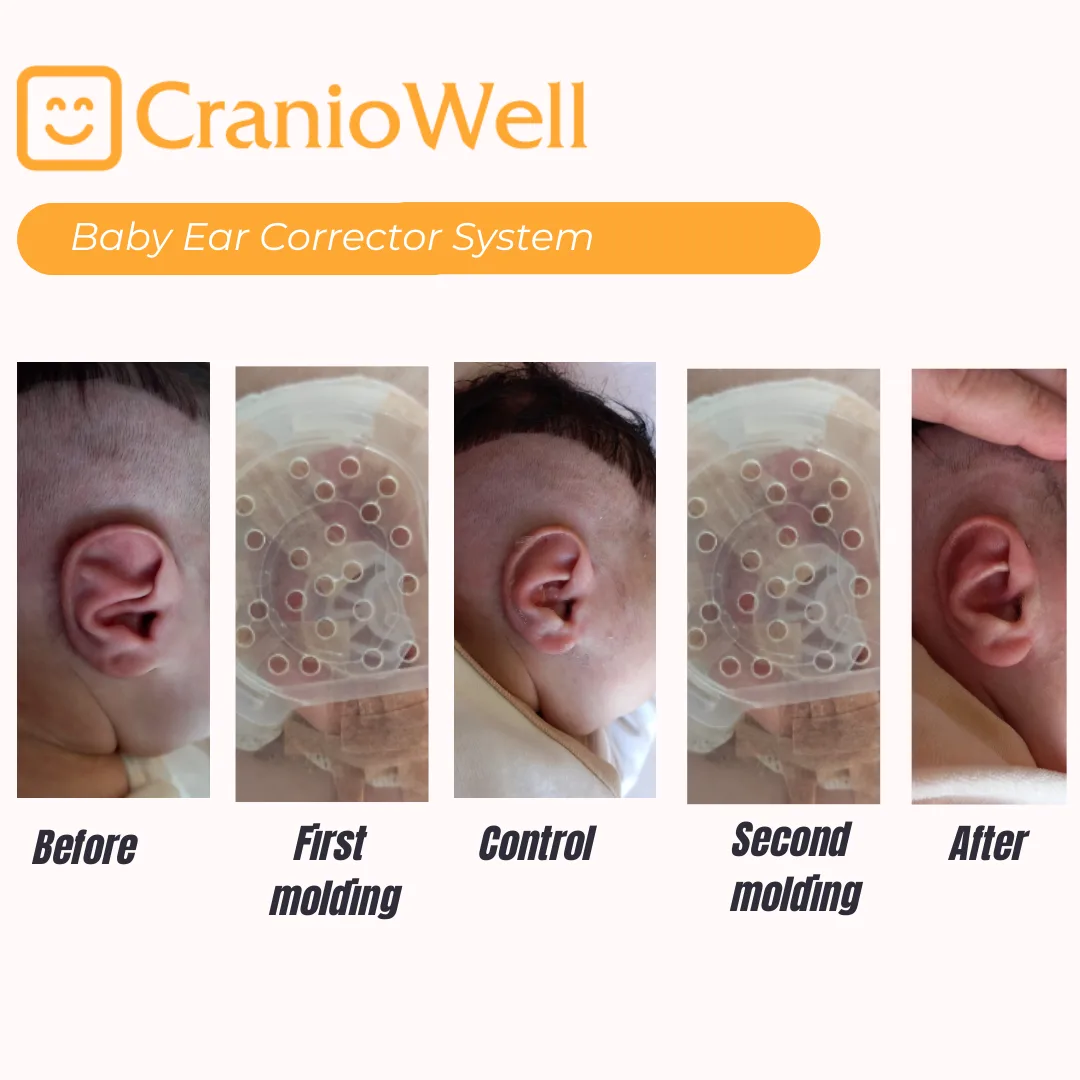
Projection can come from how the antihelix folds, how deep the concha is, or birth positioning. Some babies look more prominent on day one and soften slightly; others keep a clear angle. Anatomy basics: parts of the ear.

If a treating physician confirms the cartilage is still soft and the pattern is moldable, a wearing protocol can guide the ear closer to the head. This is different from adult otoplasty. Parent overview: baby ear molding, costs context: molding cost guide, candidacy: checklist.
Send photos through the contact form if you need help finding a physician near you.
The CranioWell baby ear corrector set is applied and followed only by treating physicians. Find the nearest one in our specialist directory. If there is no physician near you, send us a photo of your baby’s ear and your location, and we will tell you what options are available.
Shape library: prominent ears, Stahl’s ear, lop ear, cup ear, ear lidding, flat ear helix / helical rim, cryptotia, constricted ear, conchal crus, mixed ear deformity. Hub: baby ear molding.
Related: flattening newborn ears at home, how to correct prominent ears, folded ear at birth.
Unguided taping is not recommended. Skin injury and uneven pressure are real risks; ask a physician before any adhesive plan.
Hats can crease the rim and do not replace molding for true projection.
For older children and adults, surgery may be discussed. Newborns may have a non-surgical molding window first when clinically appropriate.
No CranioWell physician in your country yet? You can contact us about a distribution / partnership application for your region.