
Head Shape
Brachycephaly (Flat Head Syndrome): Signs & Symptoms
Learn how to recognise the signs and symptoms of brachycephaly (flat head syndrome) in your baby, and when to seek assessment and treatment.
Head Shape
Learn how to recognise the signs and symptoms of brachycephaly (flat head syndrome) in your baby, and when to seek assessment and treatment.
Quick answer: Brachycephaly (flat head syndrome) is the symmetric flattening of the back of the baby's skull and widening of the head to the sides. If the cephalic index exceeds 86, brachycephaly is defined. It most commonly arises from prolonged back-lying and improves with early intervention.
Brachycephaly is the symmetric flattening of the back of a baby's skull with associated widening of the head to the sides. Medically known as "Brachycephaly", this condition is commonly referred to in everyday language as "Flat Head Syndrome". Parents typically notice that the back of their baby's head is "completely flat" and that the head appears to widen to the sides rather than rising to a point.
Unlike plagiocephaly (asymmetric oblique flattening), brachycephaly involves a general flattening across the back rather than a shift to the right or left.
A baby's skull bones are very soft in the first months after birth. The most fundamental cause of brachycephaly is the baby being placed constantly on their back. While the "Back to Sleep" campaign launched in the 1990s significantly reduced Sudden Infant Death Syndrome (SIDS), as a side effect it has led to an increase in positional skull shape deformities.
Additional factors include:
You can spot the signs of flat head syndrome through simple observations at home. Here is what to look for:
The severity of these signs is determined by specialists using a measurement method called the "Cephalic Index."
In mild cases of brachycephaly, repositioning techniques and tummy time activities carried out by parents support the correction process. However, if the flattening at the back of the head is pronounced and the baby is getting older (especially after 4 months), more professional support may be needed.
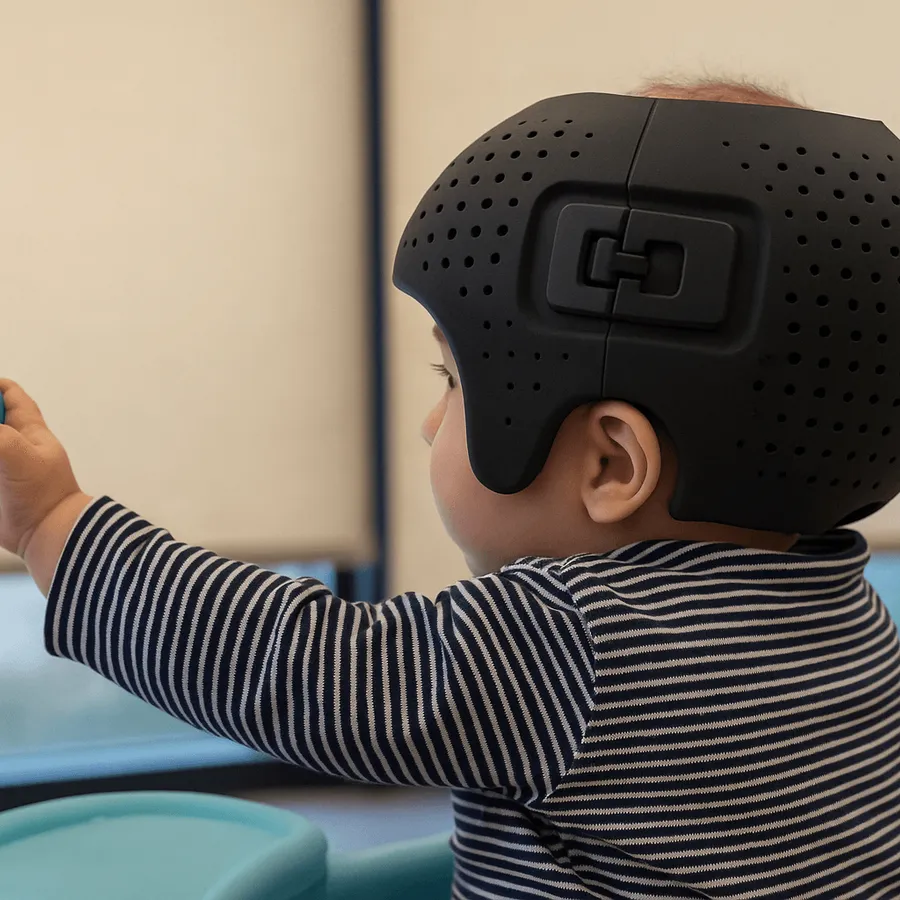
In more advanced cases, helmet therapy (cranial orthosis) is an effective method that helps correct the skull shape by bringing the skull proportions to ideal cephalic index values.
For more detail on the differences between plagiocephaly and brachycephaly, see our What Is Plagiocephaly? article.
No, brachycephaly is not a condition that directly affects brain development or cognitive functions. However, if left untreated, it can lead to permanent widening of the head and aesthetic concerns.
When babies begin to roll and sit unaided (around 6 months), the pressure on the back of the head decreases. In mild cases, improvement may be seen during this period. However, the likelihood of spontaneous correction in moderate and severe cases is low.
Yes, helmet therapy is particularly helpful in brachycephaly cases, where it restricts the widening of the head to the sides and promotes growth towards the back, helping the head shape to become more rounded.
Conclusion and Call to Action
Although brachycephaly may seem like a cosmetic issue, it can affect your baby's comfort in later life in situations such as wearing a helmet, glasses, or bicycle helmet. If you notice pronounced flattening at the back of your baby's head, you can visit CranioWell Orthopaedic Centres for a free 3D scan and learn the precise cephalic index value.
Key signs: pronounced flattening at the back of the skull when viewed from behind, prominent forehead, forward shift of the ear and facial line, head appearing wider than normal from side to side. When torticollis accompanies, asymmetry is also added to the picture.
"Flat head syndrome" is used in everyday language for both brachycephaly (bilateral flattening at the back of the head) and plagiocephaly (unilateral oblique flattening). In the medical literature, "flat head syndrome" most commonly refers to brachycephaly.
Mild brachycephaly usually causes no clinical problems beyond aesthetics. However, in moderate to severe cases, facial asymmetry, jaw and dental occlusion problems (malocclusion), and ear canal issues have been reported. This is why early assessment and, where necessary, helmet therapy is important.