
Helmet Therapy
What Is Cranial Orthosis and How Does It Work?
Cranial orthosis (baby helmet) gently redirects skull growth to correct head shape deformities. Learn the science, the process and the HKM Pro helmet.
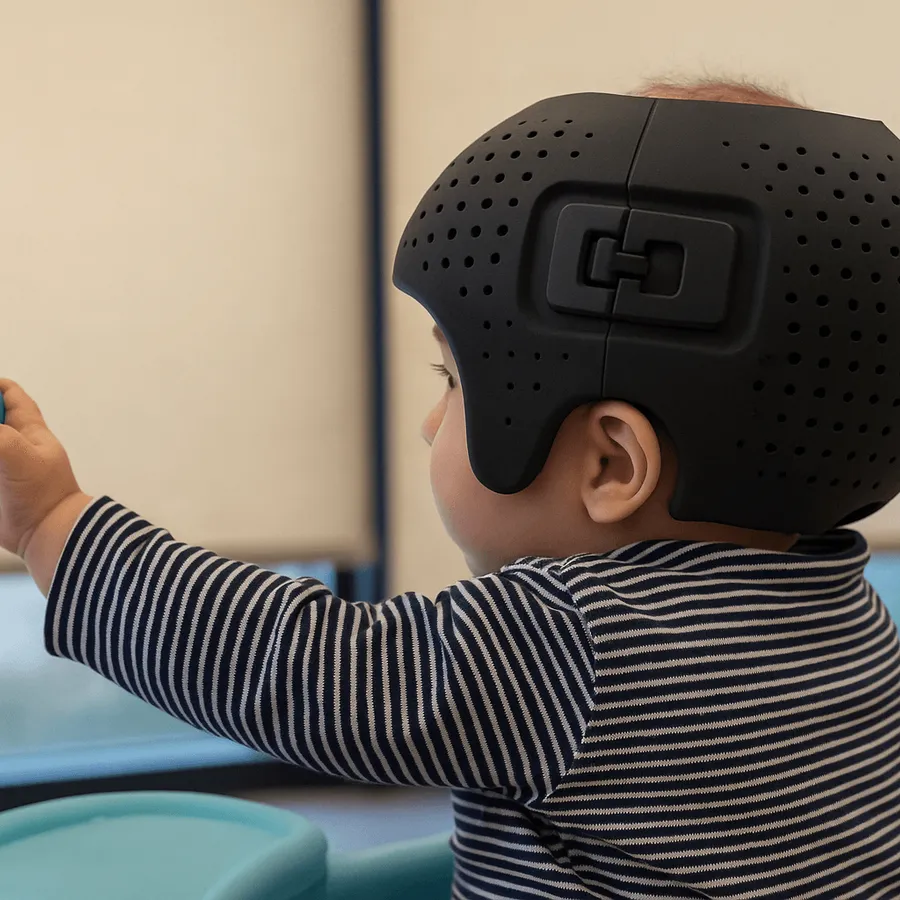
Helmet Therapy
Cranial orthosis (baby helmet) gently redirects skull growth to correct head shape deformities. Learn the science, the process and the HKM Pro helmet.
A cranial orthosis — commonly called a baby helmet or cranial remoulding orthosis — is a custom-fitted medical device worn on a baby's head to correct positional skull deformities. Unlike a bicycle helmet, it is individually produced from a 3D scan of your baby's head and designed to guide skull growth, not to protect against impacts.
At CranioWell Ortez Protez Centres, we manufacture the HKM Pro, a domestically produced cranial shaping helmet developed at Hacettepe Teknokent R&D.
In the first year of life, a baby's skull grows remarkably fast. This rapid growth is what makes cranial orthosis so effective — the same forces that cause the deformity can be redirected to correct it.
The helmet works through two complementary mechanisms:
Key point: The helmet does not squeeze or press the skull. It redirects natural growth. Your baby does the correcting — the helmet simply sets the direction.
The HKM Pro must be worn 23 hours a day. One hour per day is set aside for bathing and skin care. This schedule is non-negotiable: the skull grows continuously, including during sleep, so any longer break reduces the effectiveness of treatment.
As your baby's head grows, the helmet must be adjusted. Parents visit a CranioWell centre every 2 to 4 weeks. Our specialists trim the inner surface to open new growth space, ensuring the helmet continues to work correctly throughout treatment.
No. Properly fitted, a cranial orthosis is comfortable. There is no squeezing force. Most babies adjust within 3–5 days and show no discomfort.
The HKM Pro has a ventilated design. Dressing your baby in one less layer and keeping the room at a comfortable temperature is usually sufficient.
No. The total internal volume of the helmet is calculated to accommodate normal skull growth. Brain development is not affected.