
Helmet Therapy
What Is Helmet Therapy (Cranial Orthosis) and How Does It Work?
How cranial remolding guides growth with contact zones and open spaces, the 23-hour wear plan, acclimation, comfort expectations, and common parent questions.
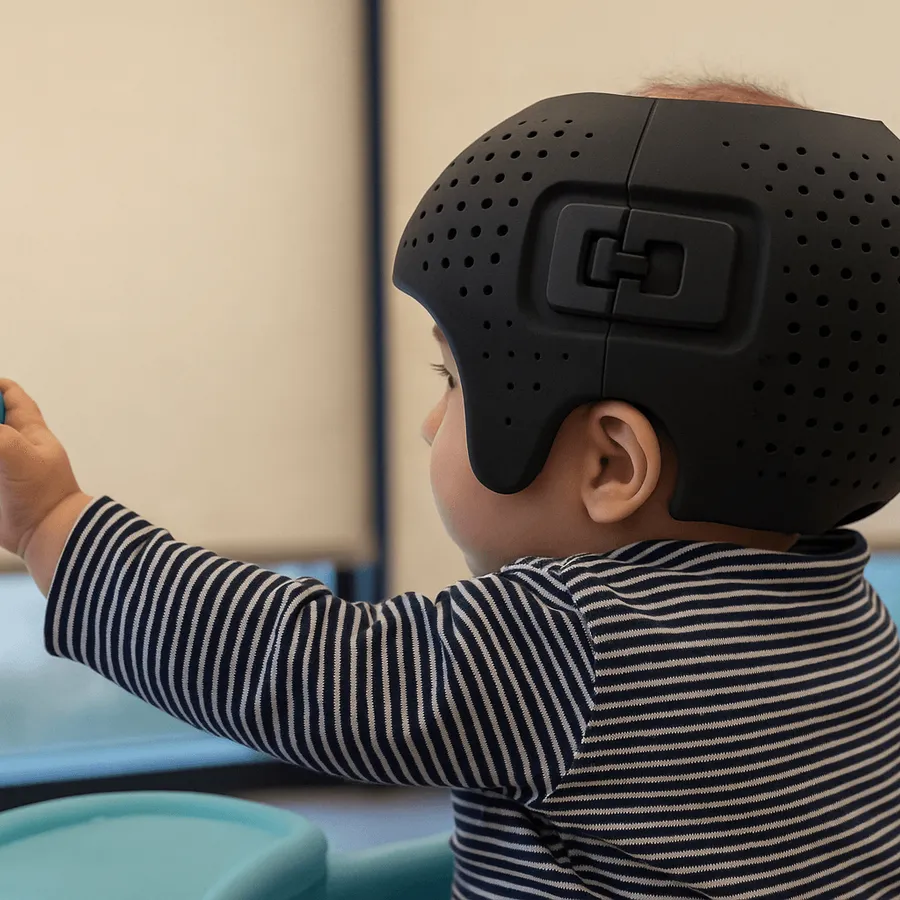
Helmet Therapy
How cranial remolding guides growth with contact zones and open spaces, the 23-hour wear plan, acclimation, comfort expectations, and common parent questions.
After a diagnosis such as plagiocephaly or brachycephaly, a clinician may mention “helmet therapy.” Parents often imagine a hard device squeezing the baby’s head.
That worry is understandable—but the mechanism is gentler. At CranioWell Orthotics & Prosthetics Centers, a cranial orthosis is a smart growth guide, not a compression clamp.
A cranial remodeling orthosis is a custom, lightweight, biocompatible medical device used for deformational infant head shape differences.
It is not a bicycle helmet. It is fabricated to millimeter precision from your baby’s 3D scan data alone. Fitting is provided only at CranioWell Orthotics & Prosthetics Centers.
Remolding is not surgery and not forceful pressing. It uses the baby’s own growth.
The inner shape lightly contacts areas that are already fuller.
Over flatter areas, strategic space is left inside the helmet.
In short: The helmet does not force the head into shape; as the baby grows, the head fills the guided form.
Modern helmets are light (often about 180–220 g) and designed for comfort.
No. Overall helmet volume is planned for expected head-circumference growth. The brain continues to grow; shape is guided.
It depends on age at start and asymmetry (for example, CVAI). Average courses are often about 3–5 months. Babies who start around 4–5 months may finish sooner.
Cranial growth is continuous. Removing the helmet for long stretches allows growth in the previous unwanted direction and can lengthen care.
Helmet therapy is a structured remolding method based on guided growth—not squeezing. Visit CranioWell Orthotics & Prosthetics Centers to learn whether your baby is a candidate.
This content is for information only and does not replace medical diagnosis or treatment.