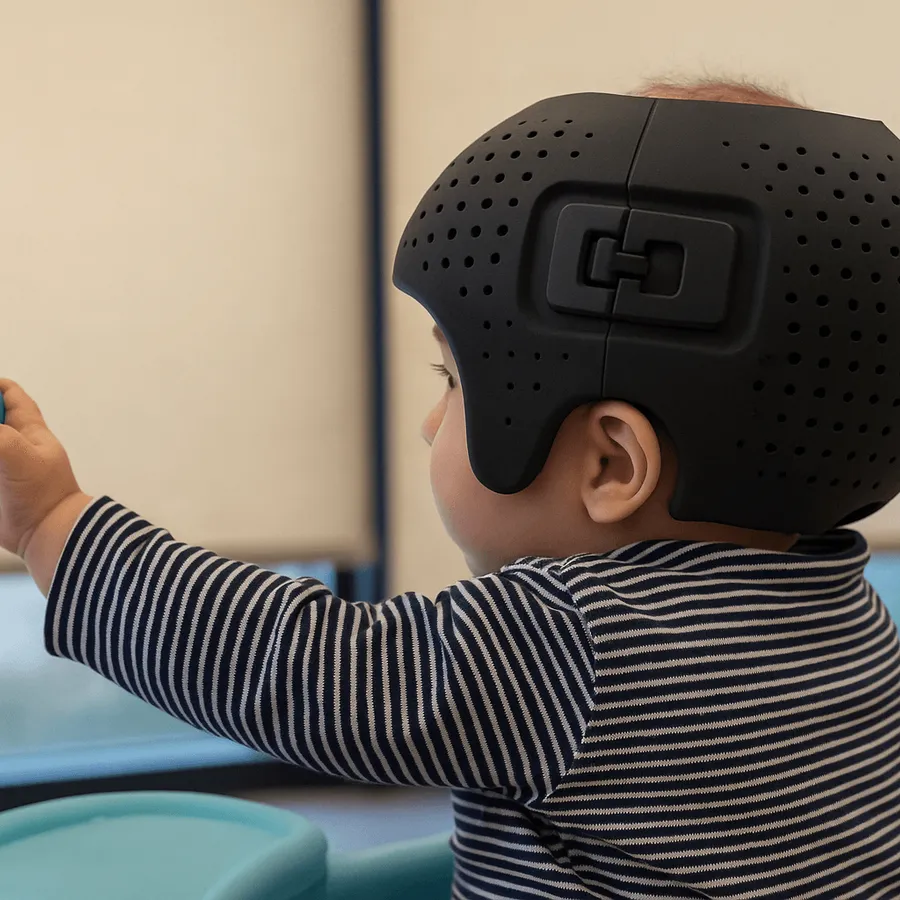
Not every baby with a head shape difference needs helmet therapy. The decision depends on several factors that a specialist evaluates at an assessment.
Short answer: Candidacy is determined by the baby's age, the severity of the asymmetry (measured by CVAI or cephalic index), the type of deformity and whether repositioning has already been tried. A 3D scan gives the most accurate picture.
What factors determine candidacy?
Age: Ideally 4–6 months; possible up to 12–18 months. After 18 months helmet therapy is generally not effective.
Severity: Mild asymmetry may resolve with repositioning alone. Moderate-to-severe asymmetry that has not improved with repositioning is the clearest indication for helmet therapy.
Type of deformity: Plagiocephaly, brachycephaly and scaphocephaly are all treatable with the HKM Pro.
Craniosynostosis: If skull sutures are prematurely fused, this must be assessed by a neurosurgeon before any helmet treatment.
How is severity measured?
CVAI (Cranial Vault Asymmetry Index): Measures diagonal difference in head length. Above 3.5% is generally considered asymmetric; above 6–7% is moderate-to-severe.
Cephalic Index (CI): Ratio of head width to head length. Used to assess brachycephaly.
3D scan: Provides precise measurements without radiation and allows progress to be tracked over time.
When is helmet therapy NOT needed?
Mild asymmetry (CVAI below 3.5%) that is improving with repositioning exercises
Babies older than 18 months
Cases of craniosynostosis (require different management)
What happens at the assessment?
Visual evaluation of head shape and ear position
Manual or 3D measurement of the head
Discussion of deformity type and severity
Recommendation: repositioning only, helmet therapy, or further imaging