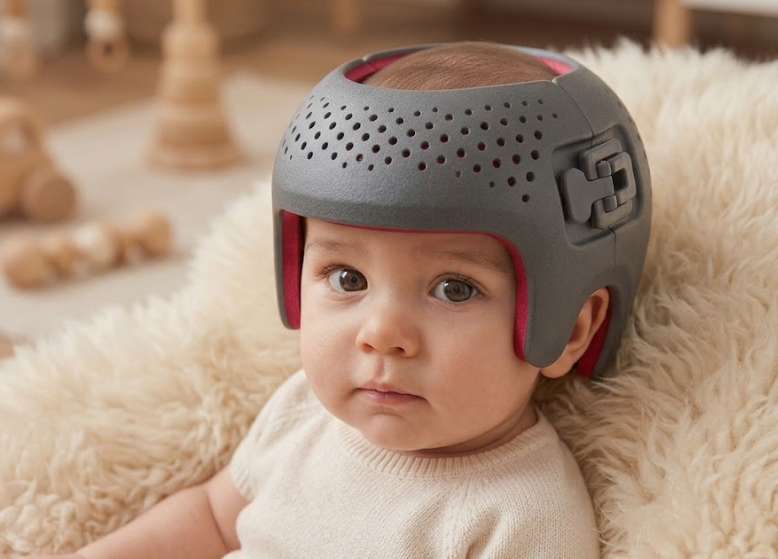
Baby helmet therapy (cranial remolding orthosis) is a non-surgical treatment that corrects positional head shape deformities in infants. The HKM Pro cranial helmet — produced in Turkey with 3D scanning-based assessment — is applied exclusively at CranioWell Orthotics & Prosthetics Centers.
Short answer: Baby helmet therapy corrects head shape deformities — plagiocephaly (flat head), brachycephaly, and scaphocephaly — by guiding skull growth without applying pressure. Most effective between 4–7 months, it uses the period of fastest skull growth to naturally reshape the head.
Which head shape conditions require helmet therapy?
Not every head shape difference requires a helmet. An in-person assessment and 3D scan determines whether helmet therapy is the right approach. The three main conditions seen at our center:
- Plagiocephaly (asymmetric flat head): One side of the back of the head is flatter than the other, causing ear asymmetry. Usually develops from consistently sleeping on one side. Related: What is plagiocephaly?
- Brachycephaly (flat back of head): The entire back of the head is flat, giving a wide, short appearance. Typically develops from back-sleeping. Related: What is brachycephaly?
- Scaphocephaly (long, narrow head): The head is long and narrow. Often seen in premature babies. Related: What is scaphocephaly?
In mild cases, repositioning and tummy time are often sufficient without a helmet.
How does helmet therapy work?
Many parents assume the helmet presses the baby's head into shape. It does not. The helmet works by leaving extra space in the flattened area of the skull, allowing natural growth to fill in that direction.
- No pressure applied: The helmet does not compress the head; it guides growth by creating space where needed.
- Growth-guided correction: Since infants' skulls grow rapidly in the first months, the helmet channels this growth toward the flattened side.
- Custom 3D fit: The HKM Pro helmet is manufactured individually from the baby's 3D scan data — no two helmets are the same.
- Daily wear: The helmet is generally worn 23 hours per day, with 1 hour set aside for bathing and skin care.
When is the ideal time to start helmet therapy?
Timing matters because the helmet works by guiding natural skull growth — the faster the skull is growing, the more effective the correction.
- 0–4 months: Repositioning and tummy time are recommended first; helmet therapy is generally not yet indicated.
- 4–7 months (ideal window): The fastest skull growth period. Assessment and treatment at this stage yields the best results.
- 7–12 months: Treatment is still effective, though the process may take longer.
- After 12 months: Helmet therapy is possible, but growth has slowed, so treatment duration increases.
Related: When should helmet therapy start?, Is helmet therapy possible after age 1?
Should a physician evaluate my baby first?
Yes. Before starting helmet therapy, your paediatrician or relevant specialist should confirm that the head shape difference is positional — not caused by premature fusion of skull sutures (craniosynostosis). Craniosynostosis requires surgical treatment, not a helmet. At CranioWell, the first appointment includes a 3D scan that supports the physician's assessment with objective measurements.
How much does helmet therapy cost? Is it covered by insurance?
Helmet cost is determined based on the baby's individual condition and treatment plan. For up-to-date information on SGK (Turkish public insurance) and private insurance coverage, please ask at your appointment or contact us by phone.
Related: Helmet therapy costs and insurance coverage.
Who applies the HKM Pro helmet?
The HKM Pro helmet is applied exclusively at CranioWell Orthotics & Prosthetics Centers. 3D scanning, custom manufacturing, fitting, and follow-up are all carried out by the same team — it cannot be fitted at another clinic or hospital.