
Head Shape
Craniosynostosis vs Positional Head Shape Concerns: A Parent Guide
How to tell positional plagiocephaly from craniosynostosis: appearance, fontanelle signs, imaging, and when surgery or helmet therapy applies.
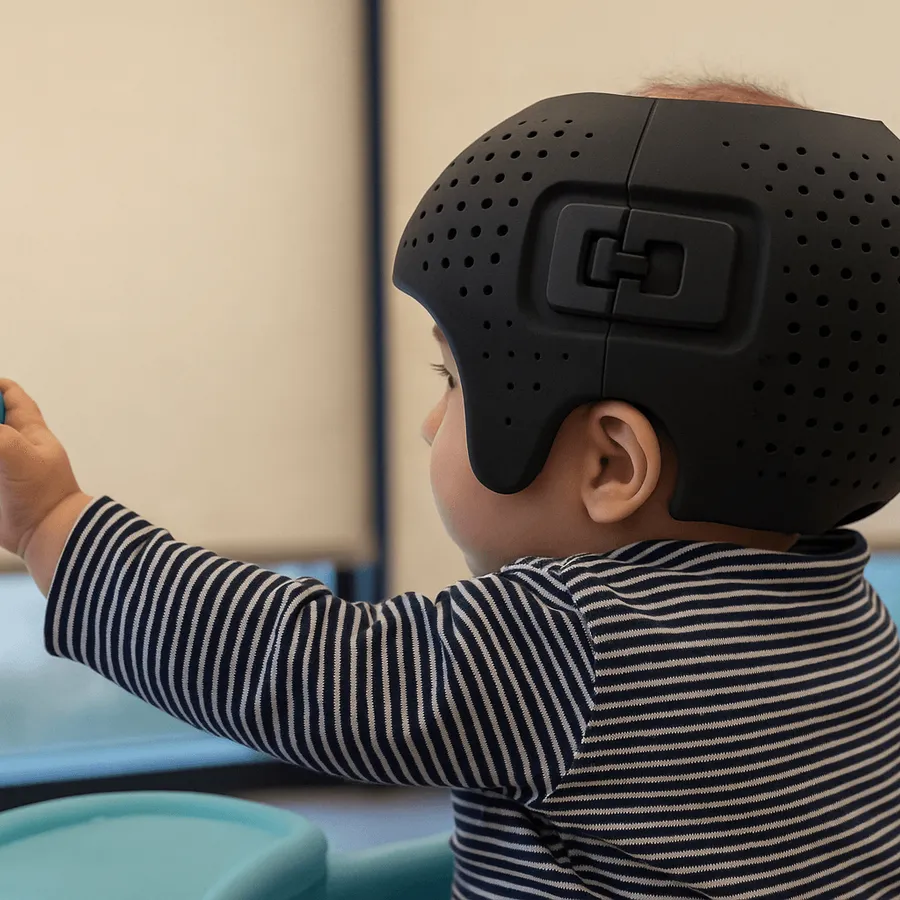
Head Shape
How to tell positional plagiocephaly from craniosynostosis: appearance, fontanelle signs, imaging, and when surgery or helmet therapy applies.
When parents notice flattening or asymmetry in a baby’s head, the first and most frightening question is often: “Is this serious—will surgery be needed?”
That worry is natural. Most infant head-shape concerns are positional (related to lying position) and do not require surgery. The rarer condition caused by premature bone fusion—craniosynostosis—is entirely different. At CranioWell Orthotics & Prosthetics Centers, we prepared this guide to clarify differences, diagnosis, and treatment paths.
The baby’s soft skull bones change shape under external forces (always lying on the same side, intrauterine crowding, and similar factors).
One or more sutures between the skull bone plates close (fuse) earlier than they should.
The table below summarizes key differences:
| Feature | Positional concern (plagiocephaly) | Craniosynostosis (bone fusion) |
| Appearance | Usually asymmetrical (parallelogram shape). | Often pointed or narrow in a specific direction (box/boat shape). |
| Ear position | Ear on the flattened side shifts forward. | Ear position usually unchanged or remains symmetric. |
| Forehead | Forehead on the flattened side bulges forward. | Forehead shows marked protrusion or flattening depending on the closed suture. |
| Fontanelle | Fontanelle is open and soft. | Fontanelle may close early or feel bulging/firm. |
| Ridge on top of the head | No firm ridge is felt. | A hard ridge can be felt with the finger over the fused suture. |
| Frequency | Very common (about 1 in 4–5 babies). | Rare (about 1 in 2,000–2,500 births). |
Parents cannot make a definitive diagnosis at home. If there is doubt, a specialist should be consulted.
The treatment routes differ completely, though they can overlap at one point.
If my baby has craniosynostosis, can a helmet be used?
If the bones are fused (synostosis), helmet therapy alone does not help and is not recommended. Surgery to open the bones is needed first. Helmet use after surgery is common.
Does a head-shape concern resolve on its own?
Mild positional concerns may improve. Craniosynostosis does not resolve spontaneously; as the brain grows, the shape concern can worsen and intracranial pressure may rise. Early diagnosis is critical.
Can a positional concern turn into synostosis later?
No. Positional plagiocephaly does not turn into bone fusion over time. They are different mechanisms. Untreated positional deformity can leave lasting asymmetry.
Worrying as a parent is normal. Remember that most head-shape concerns are positional and can often be improved without surgery through correct positioning and helmet therapy at CranioWell Orthotics & Prosthetics Centers.
If you feel a “ridge” or hardness on the skull, see your doctor; if you see flattening and asymmetry, contact us for measurement and evaluation.
This content is for information only and does not replace diagnosis or treatment.