
Helmet Therapy
Head Circumference Measurement in Babies: Why It Is Vital for Growth Monitoring
How is head circumference measured in babies, and what values are normal? Learn about growth charts, what deviations mean, and when to seek advice.
Helmet Therapy
How is head circumference measured in babies, and what values are normal? Learn about growth charts, what deviations mean, and when to seek advice.
Quick answer: Head circumference is measured at every well-baby check to monitor brain development. The 3rd–97th percentile range is considered normal. A normal circumference does NOT mean a normal head shape — a tape measure cannot detect deformity. If you notice flattening or asymmetry, a 3D scan is needed in addition to the standard measurement.
From the moment you hold your baby for the first time, every millimetre of their growth is precious to you. Alongside the routine height and weight checks at monthly doctor appointments, head circumference measurement is always included.
But have you ever wondered what your doctor is actually checking when they wrap that tape measure around your baby's head? Just the head size — or the miraculous development happening inside? At CranioWell Orthopedic & Prosthetic Centers, we explore the significance of head circumference measurement and its relationship with head shape deformities (such as flat head syndrome).
The primary purpose of tracking head circumference in babies is to indirectly monitor brain development. At birth, a baby's brain is approximately 25% of adult size. In the first 2 years, the brain grows at an extraordinary rate — and the skull bones expand to accommodate this growth.
Head circumference measurement requires precision. Parents can take measurements at home to get a general idea, but clinical measurements by a doctor remain the definitive standard.
The correct technique:
This path gives the widest circumference of the head.
Your doctor plots the measurement result on a chart (percentile table).
Consistency matters more than the number: Your baby's head may always be at the 90th percentile (larger than most peers). If it is following this curve steadily, this usually reflects a genetic family trait. However, if a baby suddenly jumps from the 50th to the 90th percentile — or drops to the 10th — this is a warning sign.
This is the point where parents most commonly misunderstand. Head shape deformities can make tape measure circumference readings misleading.
Consider a baby with Brachycephaly (Flat Head Syndrome):
For this reason, tape measure circumference alone is not sufficient to detect head shape deformity. When deformity is suspected, a 3D Scan or cross-diameter measurements (CVAI ratio) using callipers is essential.
Your paediatrician may refer you to a specialist or a centre such as CranioWell in the following situations:
The popular belief that "big-headed babies are smarter" is widespread but there is no scientifically proven direct relationship between head circumference size and intelligence level. What matters is the structural and functional health of the brain.
The angle at which the tape is held, how tightly it is applied, and the exact path it takes can change the result by 1–2 cm. For this reason, consistent measurements by the same person (your doctor) are best for reliable tracking.
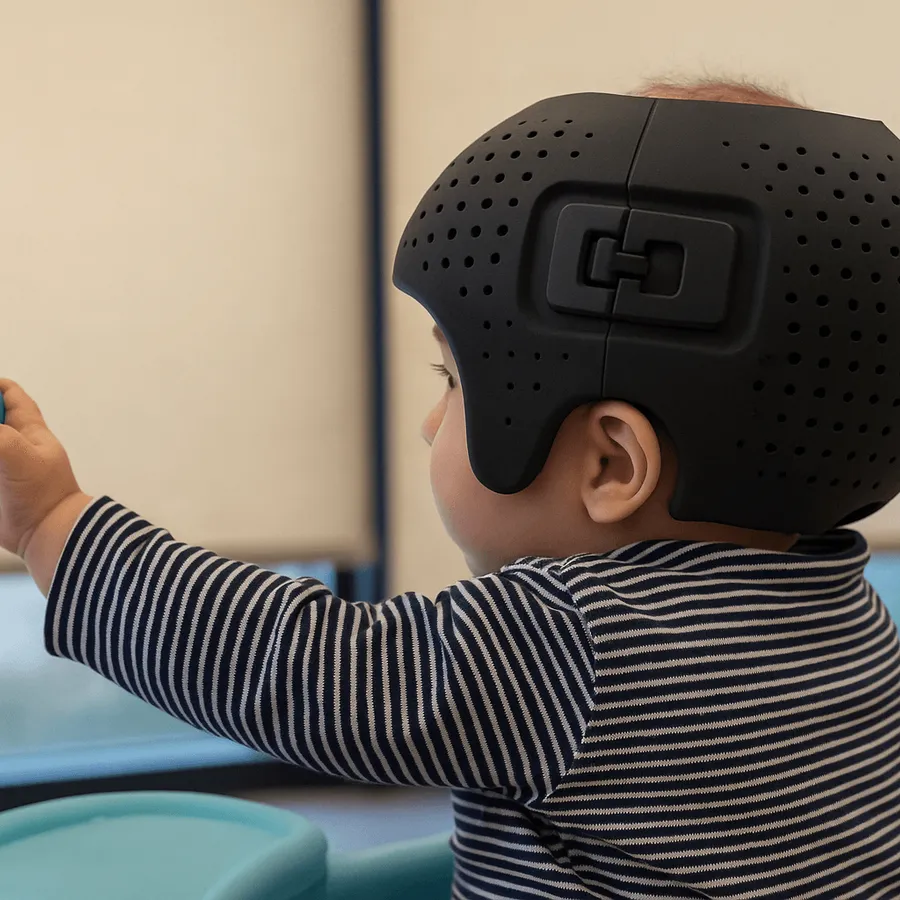
No. Helmet therapy (cranial orthosis) does not squeeze or shrink the skull. On the contrary, while head circumference continues to grow, the helmet directs this growth toward the flatter areas. After treatment, head circumference continues along the baby's natural growth trajectory.
Conclusion: Head circumference measurement is an important part of your baby's overall health picture. But remember: a "Normal measurement" does not always mean a "Normal shape."
Even if your baby's head measurements fall within the normal percentile range, if you notice flattening, asymmetry, or unexpected widening, this should be assessed from both an aesthetic and functional perspective. At CranioWell Orthopedic & Prosthetic Centers, our 3D scanning technology analyses not just the circumference but the full three-dimensional shape of the skull — giving you the most accurate picture.
Related: Baby Head Circumference Table (0–36 Months), 3D Scanning vs Tape Measure.