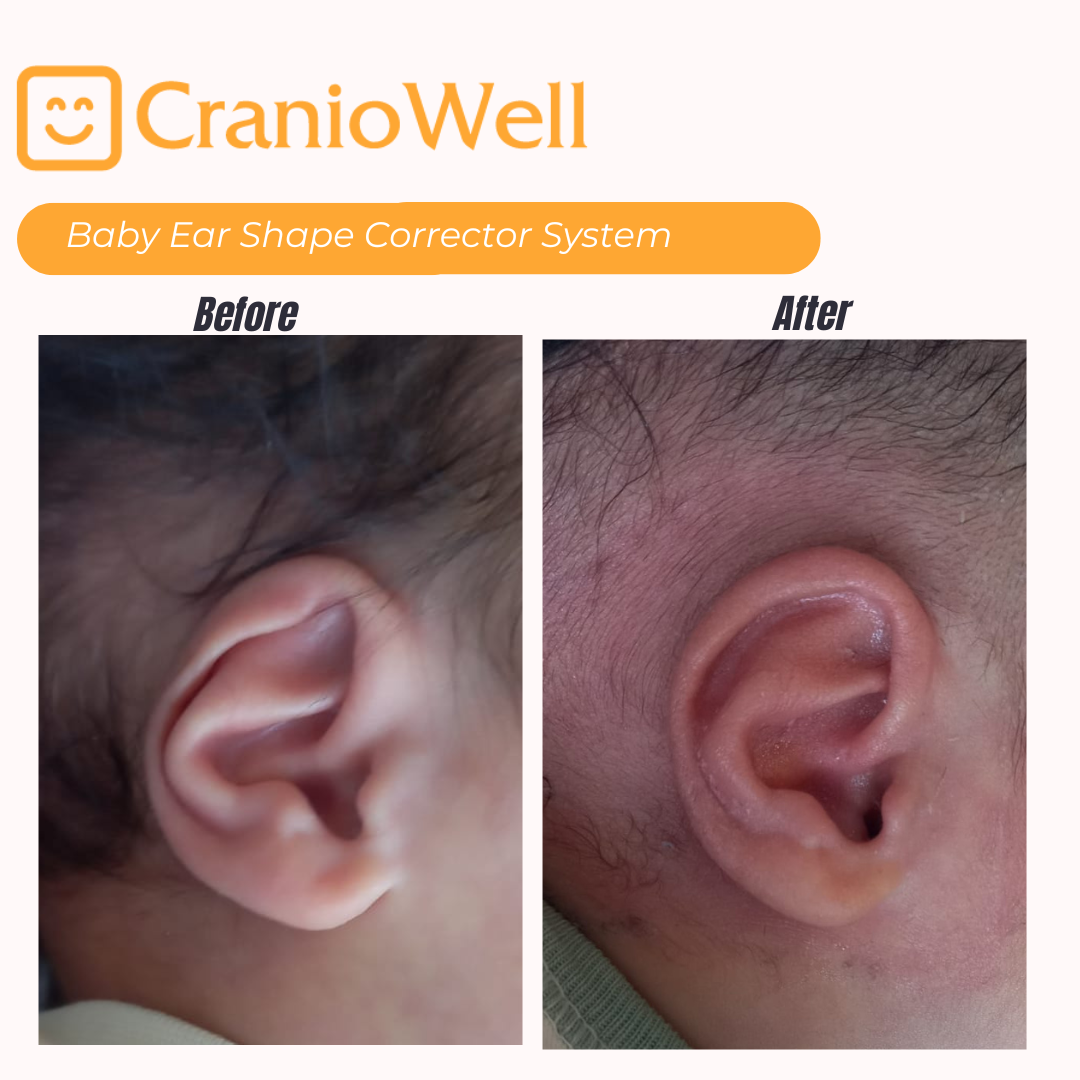
Baby ear deformities affect between 1 in 6 and 1 in 3 newborns — making them among the most common birth differences. Most are entirely cosmetic and do not affect hearing. What sets ear deformities apart from other newborn concerns is that the most effective non-surgical treatment has a window measured in weeks, not months. Missing it means surgery becomes the only option later.
What is a baby ear deformity?
An ear deformity means all the ear tissue is present, but its shape is abnormal — typically because the cartilage was folded or compressed during pregnancy or birth. Because the structure exists, it can be reshaped non-surgically while the cartilage is still soft.
This is different from an ear malformation (such as microtia), where part of the ear did not develop. Malformations cannot be molded; they require a different treatment path. A clinician examining the ear makes this distinction — parents are not expected to do so.
The 8 types of baby ear deformity
These are the most commonly treated ear deformities in newborns. Mixed patterns (more than one type in the same ear) are common.
Prominent (protruding) ears —
The ear stands away from the side of the head further than typical, often because a normal fold in the cartilage (the antihelical fold) is underdeveloped. Affects approximately 5% of the population. Usually bilateral.
Stahl's ear (elf ear / pointed ear) —
An extra cartilage fold crosses the upper ear, giving the rim a pointed or flattened appearance. Also called "Vulcan ear." Responds very well to early molding.
Lop ear / lidding —
The upper rim of the ear folds downward or forward. The top of the ear appears bent over. Can involve a large part of the ear's outer structure.
Cup ear (constricted ear) —
The upper portion of the ear appears tight, wrinkled or gathered; the ear looks smaller and cupped. Sometimes confused with prominent ears but has a different underlying cartilage structure.
Helical rim deformity —
The outer rim of the ear is flattened, compressed or irregular rather than forming a smooth curve. Can appear at any point along the rim.
Conchal crus deformity —
An unexpected fold of cartilage crosses the bowl (concha) of the ear, dividing it and pushing the ear outward.
Cryptotia (hidden ear / buried ear) —
The upper edge of the ear cartilage is tucked beneath the skin of the scalp, so the top of the ear appears partly hidden. The cartilage is present but needs to be released and reshaped.
Constricted ear —
The helical rim is folded, rolled or tight across the upper third of the ear. A range of severity exists; mild forms respond to molding, severe forms may need surgery.
Womb positioning: The baby's ear is pressed against the uterine wall or the baby's own body during the final weeks of pregnancy. This is the most common cause.
Birth canal compression: Soft cartilage can fold as the baby passes through the birth canal.
Multiple pregnancy (twins, triplets): Reduced space increases the risk of positional deformities.
Genetics: Prominent ears and some other shapes can run in families.
Amniotic band syndrome (rare): Fibrous bands in the amniotic fluid occasionally affect ear development.
In many cases no single cause is identified. The important point is that positional deformities caused by compression are the ones most amenable to early non-surgical correction.
The 6-week window: why timing matters more than anything else
After birth, maternal estrogen still circulates in the newborn's bloodstream. This hormone increases the water-binding capacity of cartilage, keeping it unusually soft and pliable. As estrogen levels fall — which happens over roughly the first 4–6 weeks — the cartilage gradually firms into its permanent shape.
This is why ear molding works so well in newborns and becomes progressively less effective after 6 weeks. The earlier treatment begins, the shorter the treatment course needed and the better the outcome.
Weeks 1–3: Optimal window. Cartilage is at its most malleable. Treatment often takes 4–6 weeks.
Weeks 4–6: Still effective but may require a longer course.
After 6 weeks: Molding becomes increasingly difficult. Some cases can still be attempted, but results are less predictable and the course is longer.
After ~3 months: Non-surgical molding is generally no longer effective. The conversation shifts to monitoring and, if desired, surgery from age 5–6.
This is fundamentally different from positional head flattening, where watchful waiting with repositioning is a reasonable first step. With ear deformities, waiting quietly removes the least invasive option. If you notice an unusual ear shape, mention it at the first newborn visit.
How does non-surgical ear molding work?
The CranioWell Baby Ear Corrector Set is a custom fitting device applied by a trained physician. It works by holding the cartilage in a corrected position continuously for several weeks. As the cartilage firms, it retains the new shape.
Assessment: The physician examines both ears and determines whether the deformity is suitable for molding.
Application: A custom-shaped retainer is fitted to the ear and secured with soft surgical tape. The process takes approximately 15–20 minutes per ear and is painless.
Duration: Typically 4–8 weeks depending on the deformity type and age at start.
Monitoring: Regular check-ups are needed to inspect the skin and adjust the device.
Success rates: When started in the first weeks of life, significant improvement is reported in the large majority of cases across published studies.
The CranioWell ear corrector set is a Turkish-manufactured, ÜTS & EUDAMED registered medical device developed with Hacettepe Technopark R&D. It is applied by trained specialist physicians — not over the counter. Related: ear molding guide, ear corrector set product page.
Do ear deformities correct on their own?
Some mild folds caused by birth canal compression do soften in the first 24–48 hours. If a shape difference is still visible after the first week, it is unlikely to self-correct. The cartilage will firm in whatever shape it is in.
Studies report that a meaningful proportion of deformities improve without treatment during the early weeks, while others persist. The practical problem is that no one can tell at day three which group a given ear belongs to — and waiting to find out can close the non-surgical window.
Missing the early window does not mean nothing can be done — it means the options shift.
Monitoring: Many ear shapes that remain are cosmetic concerns only. Regular reviews allow a family and clinician to decide together whether treatment is wanted.
Otoplasty (surgical ear reshaping): Generally considered from age 5–6, when the ear has grown close to its adult size. Requires anaesthesia and recovery time but produces reliable, permanent results. Related: ear molding vs otoplasty.
Hearing: Ear shape differences generally do not affect hearing. A newborn hearing screening is performed for every baby regardless of ear appearance.
Ear shape and head shape: what is the connection?
Parents sometimes notice that one ear appears lower or further forward than the other. This is often a head shape observation rather than an ear shape one: in positional plagiocephaly, the ear on the affected side can appear shifted relative to the other. If what you are noticing is asymmetry between the two sides rather than the contour of one ear's cartilage, the head shape guide is a better starting point.
When should I contact a specialist?
Mention any ear shape concern at the first newborn visit — ideally in the first 2 weeks. Describe what you see, when you first noticed it, and whether it has changed. Ask specifically whether non-surgical ear molding is an option and where it is offered.
Estimates vary across studies, but ear deformities are reported in 6–45% of newborns depending on how they are defined and measured. Most are mild. EarWell and other registry data suggest that approximately 20–35% of births involve some degree of auricular deformity.
Do ear deformities affect hearing?
The outer ear (pinna) is responsible for collecting and directing sound, but most ear deformities — including prominent ears, Stahl's ear, lop ear and cup ear — do not block the ear canal and do not cause hearing loss. Conditions that involve the ear canal (aural atresia) or microtia can affect hearing and are managed differently.
How early can ear molding start?
Ear molding can be started from day one of life. The earlier the better. Most protocols favour beginning in the first 1–3 weeks. Treatment begun after 6 weeks is possible but less predictable; after approximately 3 months it is generally not attempted.
Is ear molding painful for the baby?
Ear molding is described as painless. The device is secured with soft surgical tape. Babies are typically unbothered by it after the first few minutes. The main issue to monitor is skin irritation under the tape, which is why the treating physician schedules regular check-ups.
Can I do ear molding at home?
No. The CranioWell ear corrector set is applied by a trained specialist physician who assesses the ear, custom-fits the device, and monitors the skin and progress throughout treatment. Self-application risks incorrect placement, skin damage, and suboptimal results.
What is the difference between ear molding and taping?
Ear taping uses adhesive tape to hold the ear in position without a custom-shaped retainer. It is sometimes used for mild prominent ears. Ear molding uses a device shaped to the specific deformity, which provides more precise correction across a wider range of deformity types. Related: ear molding vs taping.
Will my child need surgery?
If treatment starts in the first weeks of life and the deformity is suitable for molding, surgery is often avoided entirely. If the window has passed or the deformity is not amenable to molding, otoplasty from age 5–6 is the standard surgical option. Whether to pursue surgery is a decision for the family and specialist together.