
Helmet Therapy
How Is Suitability for Helmet Therapy Determined? Criteria and Age Range
Learn the age windows, CVAI thresholds, and diagnostic criteria CranioWell uses to decide when cranial helmet therapy is appropriate for infants.
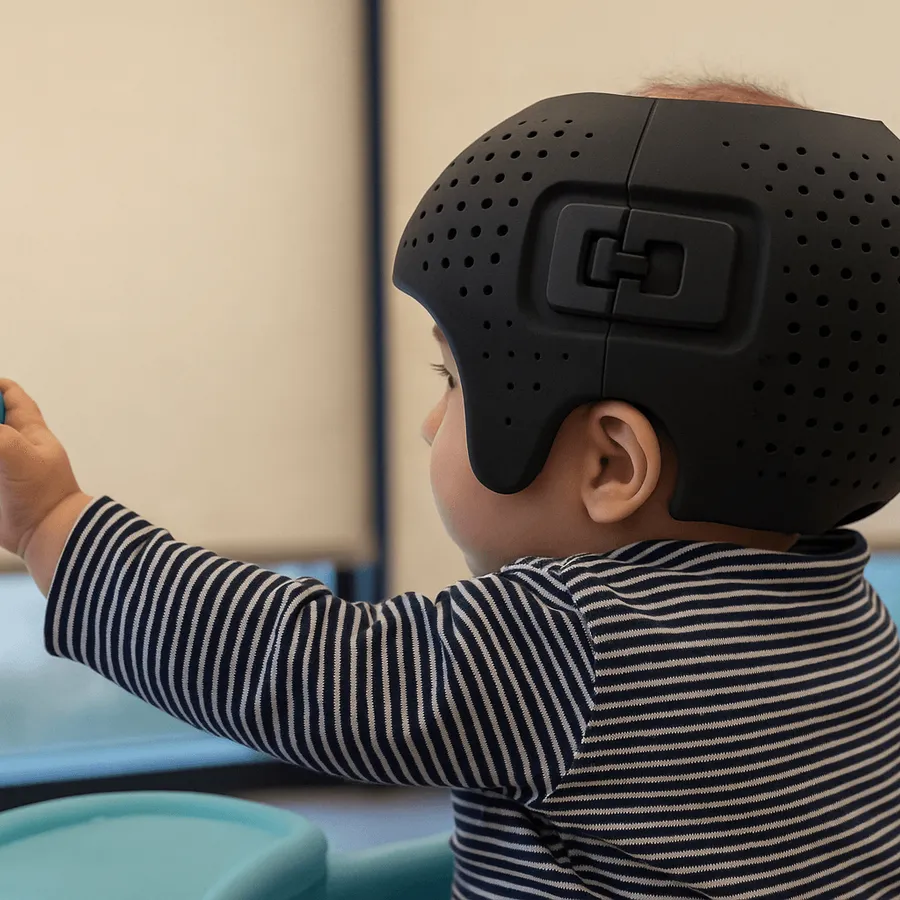
Helmet Therapy
Learn the age windows, CVAI thresholds, and diagnostic criteria CranioWell uses to decide when cranial helmet therapy is appropriate for infants.
You are concerned about flattening or asymmetry in your baby’s head shape and looking for solutions. Online you have likely encountered “helmet therapy” (cranial orthosis). One question remains: “Is my baby a suitable candidate for this treatment?”
Helmet therapy is not a standard procedure for every head-shape concern. As with a medication or surgical intervention, it has specific indications (conditions for use) and timing. At CranioWell Orthotics & Prosthetics Centers, we recommend this treatment only when medical criteria are met. Here are those criteria:
Outcomes with helmet therapy relate closely to the infant’s age and the rate of skull growth.
As detailed in our previous article, the Cranial Vault Asymmetry Index (CVAI) provides an objective basis for decision-making. A visual impression of “a little uneven” is not enough.
Helmet therapy (cranial orthosis) is used on its own only for positional (deformational) head-shape concerns:
When it is not used alone (contraindications):
At CranioWell, suitability is decided in three steps:
No. Meaningful improvement is still often seen between 12 and 14 months. The course may simply last longer than for a 4-month-old (for example, 5–6 months instead of 3). What matters is that the fontanelle and sutures are still open.
Advanced deformational plagiocephaly is not only an aesthetic issue. Later challenges with the jaw joint (TMJ), glasses or helmet fit, and facial asymmetry may occur. Social and psychological effects should also be considered. The decision always belongs to the family.
Yes. Before starting helmet therapy at CranioWell Orthotics & Prosthetics Centers, we strongly recommend that your baby be evaluated by a pediatrician or relevant specialist to confirm there is no underlying pathology such as synostosis.
Helmet therapy is not a “miracle”; it is a medically grounded process. The most important step for a good outcome is appropriate patient selection.
If you are unsure whether your baby meets the criteria, do not rely only on online comments. Visit a CranioWell Orthotics & Prosthetics Center for a free 3D scan. Using the data, we can set an honest, transparent plan for your baby together.
This content is for information only and does not replace medical diagnosis or treatment.