
Head Shape
What Is Torticollis? Effects on Infant Head Shape | CranioWell
Congenital muscular torticollis explained—causes, signs, the link with plagiocephaly, physiotherapy, and when cranial helmet therapy at CranioWell may help.
Head Shape
Congenital muscular torticollis explained—causes, signs, the link with plagiocephaly, physiotherapy, and when cranial helmet therapy at CranioWell may help.
Looking at your baby’s photos, do you notice the head always tilting the same way? Or when you hold, feed, or put the baby down, does the head insistently turn to one side?
If the answer is “yes,” your baby may have torticollis (wry neck). Beyond limiting neck motion, it is a major trigger for head shape differences (flat head syndrome). At CranioWell Orthotics & Prosthetics Centers, we explain this cycle and how families can address both issues.
Medically called congenital muscular torticollis (CMT), it involves shortening or tightness of the sternocleidomastoid (SCM) muscle on one side of the neck.
This muscle runs from behind the ear to the collarbone and breastbone. When one SCM is short, the head tilts toward that side while the chin turns toward the opposite shoulder—like a tight rubber band holding the head in place.
Torticollis is usually present from birth, though signs may become clearer after a few weeks.
Torticollis and plagiocephaly (flat head syndrome) often travel together. Many babies with head shape differences also have limited neck motion. How the cycle works:
ol start="1" class="wp-block-list">Parents should watch for:
When torticollis and head shape difference occur together, both should be addressed.
Primary treatment for torticollis is physiotherapy. Stretching and strengthening with a physiotherapist lengthen the muscle. Home exercise consistency is essential.
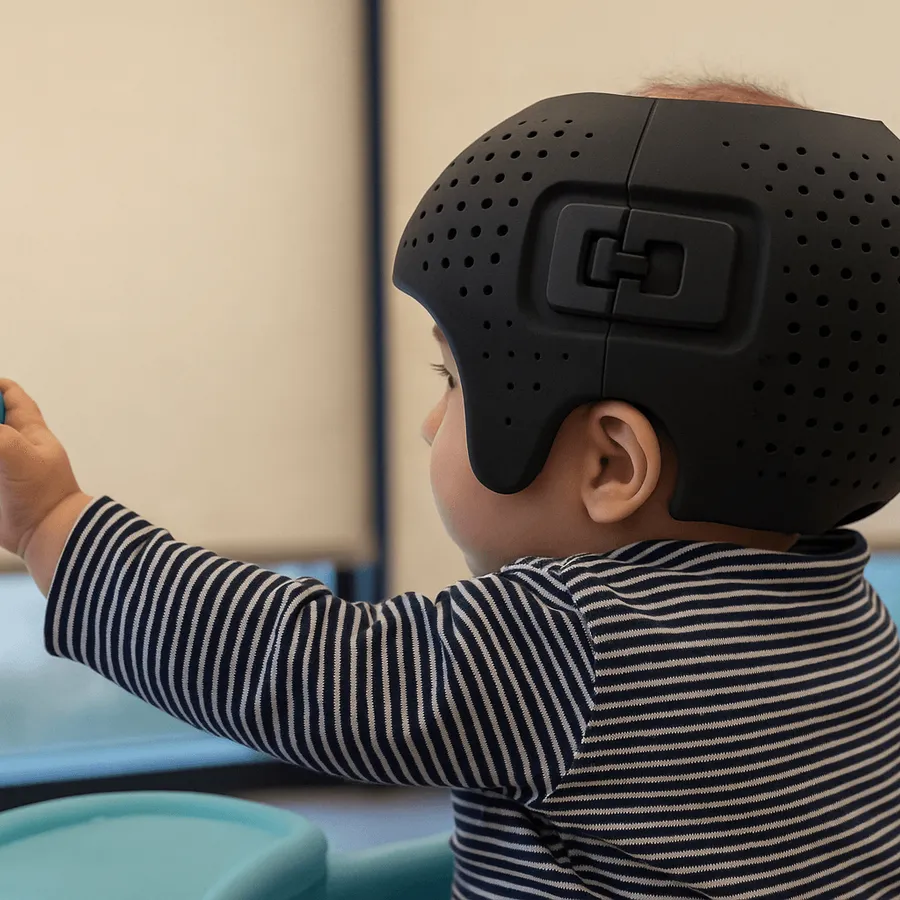
If moderate to severe flattening has developed, exercise alone may not reshape the head. Helmet therapy can then be considered. By rounding the flat occipital area, the helmet can make it physically easier for the baby to turn the other way and support physiotherapy. CranioWell helmets are fitted only at CranioWell Orthotics & Prosthetics Centers.
Supervised prone play while awake is a natural way to strengthen neck muscles.
Very mild cases may improve, but most need intervention. Untreated torticollis can contribute to lasting facial asymmetry and posture problems such as scoliosis risk later.
The helmet does not treat the neck muscle directly—that is physiotherapy’s role. By improving the flat spot, it can increase ease of head turning. The two approaches complement each other.
Start with a pediatrician; depending on findings, pediatric orthopedics, physical medicine, physiotherapy, and evaluation at a cranial center such as CranioWell may be appropriate.
A constant head-turn preference may be an anatomical need, not stubbornness. Early recognition matters for both neck recovery and preventing lasting head shape change.
At CranioWell, babies referred for head shape concerns also receive careful neck screening, and families are directed to physiotherapists when needed for multidisciplinary care.
This content is for information only and does not replace diagnosis or treatment.