
Helmet Therapy
Head Shape Concerns in Premature Babies: Causes and Solutions
Why preterm infants develop NICU-related scaphocephaly, how corrected age guides timing, and when CranioWell helmet therapy may help reshape the head.
Helmet Therapy
Why preterm infants develop NICU-related scaphocephaly, how corrected age guides timing, and when CranioWell helmet therapy may help reshape the head.
Tiny heroes… They start life a little early, a little hurriedly. Having a premature baby is a long marathon of worry and hope for parents. In the Neonatal Intensive Care Unit (NICU), the priority is always breathing, feeding, and holding on to life.
After that hard process is completed and the family goes home, parents often notice something: the baby’s head may look longer, narrower, or flatter at the sides than expected. Head-shape concerns in premature babies are a common part of this journey. At CranioWell Orthotics & Prosthetics Centers, we summarize the causes and safe paths forward for your little fighter.
Compared with term infants, early-born babies have a higher rate of head-shape concerns (especially scaphocephaly/dolichocephaly). Biological and environmental factors underlie this:
Hardening (mineralization) of the baby’s bones accelerates in the last trimester. Preterm infants are born before this process finishes. Their skull bones are as soft as modeling clay and much more vulnerable to external pressure.
In intensive care, babies often need to lie on their side for breathing support or comfort.
Preterm infants’ neck muscles are not yet strong enough to move the head well. Once the head rests to one side, the baby often cannot turn it the other way, so pressure stays on the same point for long periods.
In developmental follow-up and helmet therapy for premature babies, we consider corrected age, not only chronological age (days since birth).
What is corrected age? It is found by subtracting the number of weeks the baby was born early from the chronological age.
Why does this matter? When deciding on head-shape care or assessing development, we treat your baby as biologically 2 months old, not 4. That can reassure families who fear they are “too late”—calendar age may look older while biological timing is still suitable to begin evaluation.
Mild deformities may improve somewhat after the baby comes home, neck muscles strengthen, and movement (rolling) increases. However:
For head-shape concerns in premature babies, the CranioWell approach is:
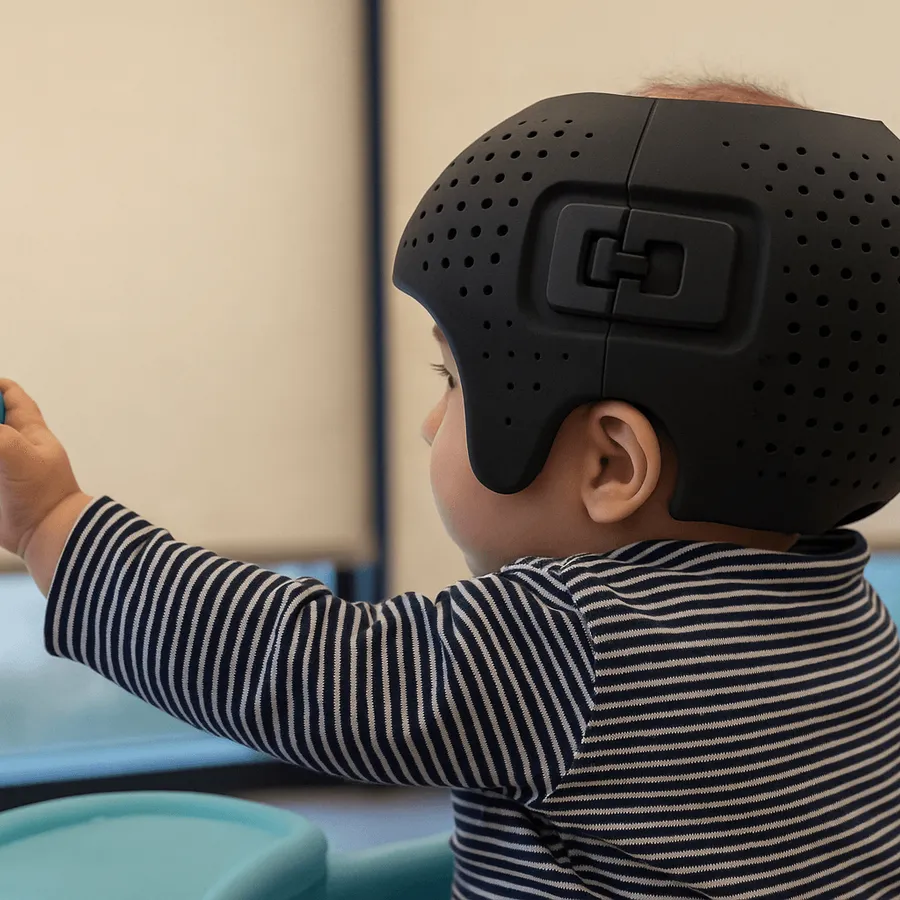
No. CranioWell helmets are made from advanced lightweight materials. Weight is typically in a range the infant’s neck can carry (often about 150–200 g) and does not overload the baby.
No. A deformational shape concern does not damage brain tissue or cause intellectual disability. Correction is still often recommended for aesthetic reasons and later functional issues such as helmet or glasses fit.
Around the 3rd or 4th month of corrected age is a preferred time for evaluation in premature infants. Earlier intervention often shortens the overall process.
You have left the hardest days behind; now it is time to enjoy your baby’s development. Head-shape concerns in premature babies are manageable when addressed appropriately.
If you are worried about your little fighter’s head shape, we can provide an evaluation based on corrected age at a CranioWell Orthotics & Prosthetics Center. Our 3D scanning technology allows measurement in seconds without touching or frightening the baby.
This content is for information only and does not replace physician diagnosis or treatment.