
Helmet Therapy
Helmet Therapy for Your Baby: Frequently Asked Questions
FAQ on how cranial helmets work, who may be a candidate, wear time, follow-up visits at CranioWell centers, and insurance notes for infant helmet therapy.
Helmet Therapy
FAQ on how cranial helmets work, who may be a candidate, wear time, follow-up visits at CranioWell centers, and insurance notes for infant helmet therapy.
Helmet therapy is used to gently guide the shape of a baby’s skull over time. A newborn’s skull is made of bones with soft areas between them. As the baby grows, these plates expand, gradually harden, and knit together.
Sometimes, when a baby sleeps in the same position, soft areas can develop a flat spot or uneven look. This common condition is called plagiocephaly and is not dangerous for your baby’s brain. If it does not improve on its own, your pediatrician may recommend repositioning, exercises, or helmet therapy.
In other cases, skull plates fuse too early or abnormally. That condition is called craniosynostosis and may require surgical treatment, with or without a helmet afterward.
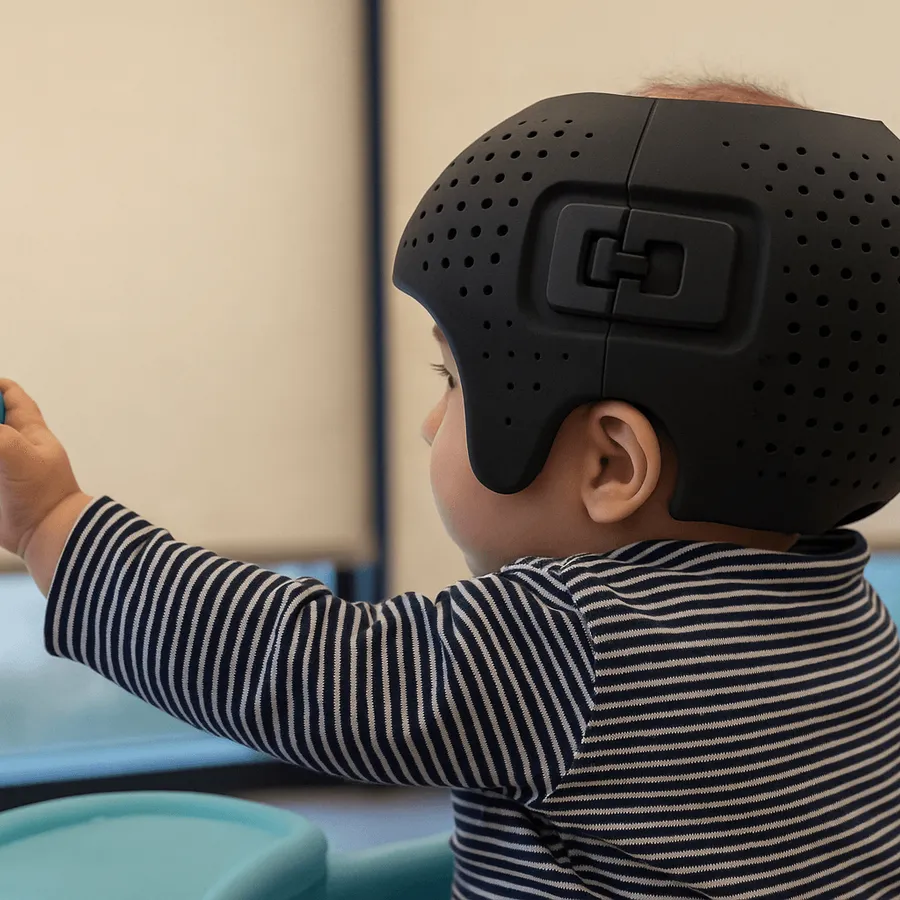
Cranial remolding helmets are usually made with a firm outer shell and a foam liner. They guide natural growth by allowing more expansion in flatter areas while limiting further growth in more prominent areas. Helmet therapy for infant head shaping is generally more responsive when started within the first 6 months.
As your baby’s head grows, frequent adjustments are made. The helmet essentially provides a guided, rounded space for growth. Even if your child still prefers resting to one side, the helmet helps cushion and limit further flattening.
If your child is diagnosed with deformational plagiocephaly, brachycephaly, or scaphocephaly and is under 12 months of age, a cranial remolding helmet may be recommended. A helmet should be prescribed by a physician. Not every baby is an appropriate candidate—discuss this carefully with your clinician.
In addition, children who undergo endoscopic surgery for craniosynostosis are often given helmet therapy afterward to further support head shape.

In Türkiye, SGK currently does not pay for infant helmet costs. Some private health insurance plans may cover helmet therapy—check your policy details.
Infant helmet prices vary. Material properties and the care pathway can affect cost.
Pricing is usually set by the care package rather than by charging a different fee for every deformity grade. Many pathways are completed with a single helmet and a single care fee.
Yes. The usual plan is about 23 hours of wear per day.
It can be removed for bathing. At other times—play, sleep, or feeding—your baby generally stays in the helmet. Hearing that your baby may spend developmental months in a helmet can feel shocking at first. What we emphasize is that helmets are usually well tolerated and do not need to restrict typical activities.

Average treatment with a helmet is often about three to four months, but duration varies with age and severity. Careful, frequent monitoring is needed to confirm that reshaping is progressing as planned.
Visit frequency depends on severity. A common helmet follow-up schedule after fitting is:
While your baby wears a custom helmet and adjustments are made, you will have regular visits at CranioWell Orthotics & Prosthetics Centers, where the HKM Pro helmet is fitted and adjusted. Your physician remains part of the overall medical care plan. The schedule above can vary with deformity severity.
