
Helmet Therapy
Infant Fontanelle Closure and Helmet Therapy
When does the fontanelle (soft spot) close? What early or late closure means, when to worry, and why an open fontanelle does not block cranial helmet therapy.
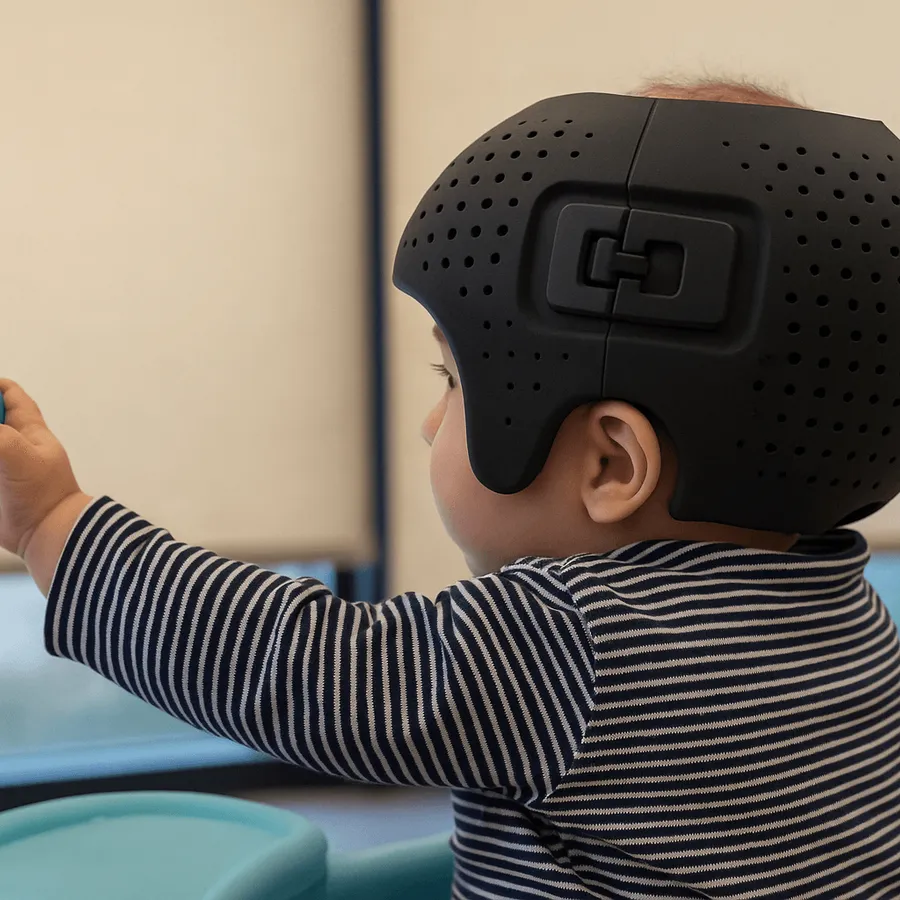
Helmet Therapy
When does the fontanelle (soft spot) close? What early or late closure means, when to worry, and why an open fontanelle does not block cranial helmet therapy.
What is the fontanelle?
The fontanelle (soft spot) is a gap between the skull bones of a newborn, covered by a tough membrane. It allows the skull to flex during birth and gives the brain room to grow rapidly in early infancy. There are typically two fontanelles at birth: the larger anterior (front) fontanelle and the smaller posterior (back) fontanelle.
If the anterior fontanelle closes before 6 months, it may indicate craniosynostosis (early fusion of skull sutures). Not every early closure means craniosynostosis — head growth curve, skull shape, and clinical findings are assessed together. A physician evaluation is essential.
A mildly sunken fontanelle when a baby is held upright is normal. A pronounced, persistently sunken fontanelle may suggest dehydration — contact your pediatrician. A bulging, tense fontanelle may indicate increased intracranial pressure and requires urgent evaluation.
ta-cw="quick-answer">Quick answer: The fontanelle (soft spot) on a baby's head is where skull bones have not yet fused. The anterior (front) fontanelle typically closes between 9–18 months; the posterior (back) fontanelle closes within 1–2 months of birth. An open fontanelle does not block cranial helmet therapy.One of the areas new parents fear most is the soft spot on top of the baby’s head: the fontanelle. They hesitate to touch it and are extra careful during baths. Folklore even claims “touching the fontanelle affects intelligence”—which is not true.
Medically called the fontanelle, this soft area plays an important role in healthy development. So when does the infant fontanelle close, and how does it relate to head shape care (helmet therapy)? At CranioWell Orthotics & Prosthetics Center, we clarify this sensitive topic for parents.
Fontanelles are soft, membrane-covered spaces where the skull bones meet and have not yet fully ossified. Babies usually have about six fontanelles; the most important are the anterior and posterior fontanelles.
Nature leaves these spaces for two main reasons:
Every baby’s timeline differs, but commonly accepted ranges are:
Important: Very early closure of the anterior fontanelle (for example at 3 months) or a fontanelle still open after age 2 should be evaluated by a clinician.
A common parental worry is: “Will the helmet press on my baby’s fontanelle and harm the brain?”
The clear answer is no—when a properly designed custom helmet is used.
Custom CranioWell helmets are made to fit the baby’s head with millimeter-level care. Internal design avoids harsh, direct pressure over the fontanelle. The goal is not to squeeze the head, but to redirect growth. Fitting is done only at CranioWell Orthotics & Prosthetics Centers.
Helmet therapy (cranial orthosis) works while skull bones are still mobile and growing.
Helmet therapy starts at 4 months at the earliest; the most effective period is 4–7 months, and the effect decreases after 12 months. If the fontanelle and sutures are fully closed (ossified), meaningful shape change with a helmet becomes much harder or may no longer be realistic. That is why earlier recognition matters.
A clearly sunken fontanelle can be a sign of dehydration—for example when feeding is inadequate or with diarrhea/vomiting. Seek medical care promptly.
Yes. Vessels are dense in that area, and you may see gentle rise and fall with heartbeat or crying. This reflects circulation, not a problem by itself.
Vitamin D at the dose your clinician recommends does not prematurely close the fontanelle; it supports bone development. Do not stop vitamin D on your own because the fontanelle “looks small.”
The infant fontanelle is a natural developmental window. For helmet therapy it is not an obstacle—it is part of why guided growth can work.
If your baby has a head shape concern and you delay care out of fear for the fontanelle, you may lose valuable time. Interventions while the fontanelle and sutures are open are generally more responsive.
At CranioWell Orthotics & Prosthetics Center, your baby’s head structure and fontanelle status can be evaluated, and you can learn about safe care options.
This content is for information only and does not replace physician diagnosis or treatment.