
Helmet Therapy
Helmet Therapy: A Family Guide to Healthy Head Development
How families support cranial remolding—from early recognition and 23-hour wear to follow-up adjustments, comfort tips, and how helmets compare with other options.
Helmet Therapy
How families support cranial remolding—from early recognition and 23-hour wear to follow-up adjustments, comfort tips, and how helmets compare with other options.
Infant head shape differences can worry parents. Helmet therapy (cranial orthosis) is a non-surgical option that can help guide selected patterns. Family understanding, patience, and daily adherence strongly influence how smoothly the pathway goes. Remolding is not only a device—it is a coordinated journey.
Newborn skulls are flexible so the head can pass through the birth canal. That flexibility also makes the skull more responsive to external pressure.
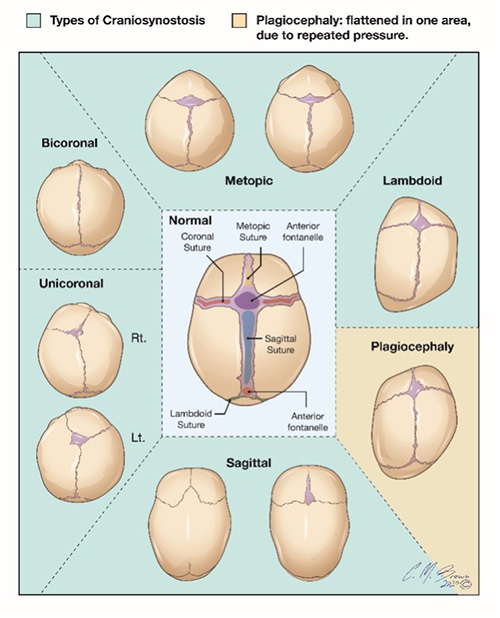
Flattening on one area after prolonged resting on the same surface—often increased with recommended back sleeping.
Wider side-to-side diameter with a shorter front-to-back dimension and a flatter appearance.
A longer, narrower vault; front and back may look more prominent.
Less common and more serious. Early fusion can limit space for brain growth and usually needs surgical planning. Helmets may support shape after surgery in selected pathways.
Early recognition and an appropriate plan matter for appearance and for related developmental support when neck imbalance is present.
A cranial orthosis gently guides growth: it limits expansion where the skull is fuller and leaves space where growth is needed, so the head can become more balanced over time.
Mechanism:
The process is typically painless. Results vary with age at start, severity, growth rate, and family adherence. The HKM Pro remolding helmet is fitted only at CranioWell Orthotics & Prosthetics Centers.
| Approach | Role and usefulness | Advantages | Limitations |
|---|---|---|---|
| Repositioning | Mild plagiocephaly/brachycephaly; changing sleep and play positions | No device; low cost | May be insufficient in moderate/advanced cases; needs constant attention |
| Tummy time | Reduces occipital pressure; supports motor skills | Natural; no device cost | Time-consuming; not enough alone for advanced flattening |
| Helmet therapy | Moderate/advanced positional patterns; also post-craniosynostosis surgery in selected cases | Non-surgical; structured remolding with consistent wear | Cost; adaptation period; requires adherence and visits |
| Surgery | Craniosynostosis or rare cases not suited to orthosis alone | Addresses structural fusion | Higher risk, longer recovery, higher cost |
When timing and diagnosis are appropriate, helmet therapy is a commonly used non-surgical option. Family partnership with the care team is essential.
For more information or an appointment:
CranioWell Orthotics & Prosthetics Center
Address: Prof. Dr. Ahmet Taner Kışlalı, Bangabandhu Blv. Özçelik-Pelit Business Center No:94 /30, 06810 Çankaya/Ankara
Phone: 0551 706 87 19