
Helmet Therapy
Why Head Shape Differences Are More Common in Twins
How intrauterine crowding, mirror-image plagiocephaly, prematurity, and torticollis raise flat-head risk in twins—and practical steps families can take.
Helmet Therapy
How intrauterine crowding, mirror-image plagiocephaly, prematurity, and torticollis raise flat-head risk in twins—and practical steps families can take.
Remember learning you were expecting twins? That mix of surprise and joy often turns into busy days of feeding, settling, and growing two babies at once. One detail many twin parents notice is flattening on one or both babies’ heads.
Clinical observations show that head shape differences in twins (plagiocephaly or brachycephaly) occur more often than in singleton pregnancies. Why? CranioWell Orthotics & Prosthetics Centers explain the special factors in multiple pregnancy and practical next steps.
In a singleton pregnancy the baby usually has more room to move. In twins or triplets, space is shared and becomes especially limited late in pregnancy.
Clinicians call this intrauterine constraint.
Twins often show mirror-image plagiocephaly. Intrauterine position may keep one baby’s head pressed on the right and the other’s on the left.
Premature infants have softer bones. A large share of twin pregnancies deliver early (often cited around 60%).
Crowding affects neck muscles as well as cranial bones. A shortened sternocleidomastoid (SCM) muscle can make turning difficult, so the baby always lies on the same side and flattening progresses. Torticollis is seen more often in twins than in singletons.
Caring for twins is physically demanding.
Head shape differences in twins can often be managed with the right plan.
Yes. Intrauterine position can compress one baby more than the other. Each twin may be affected differently.
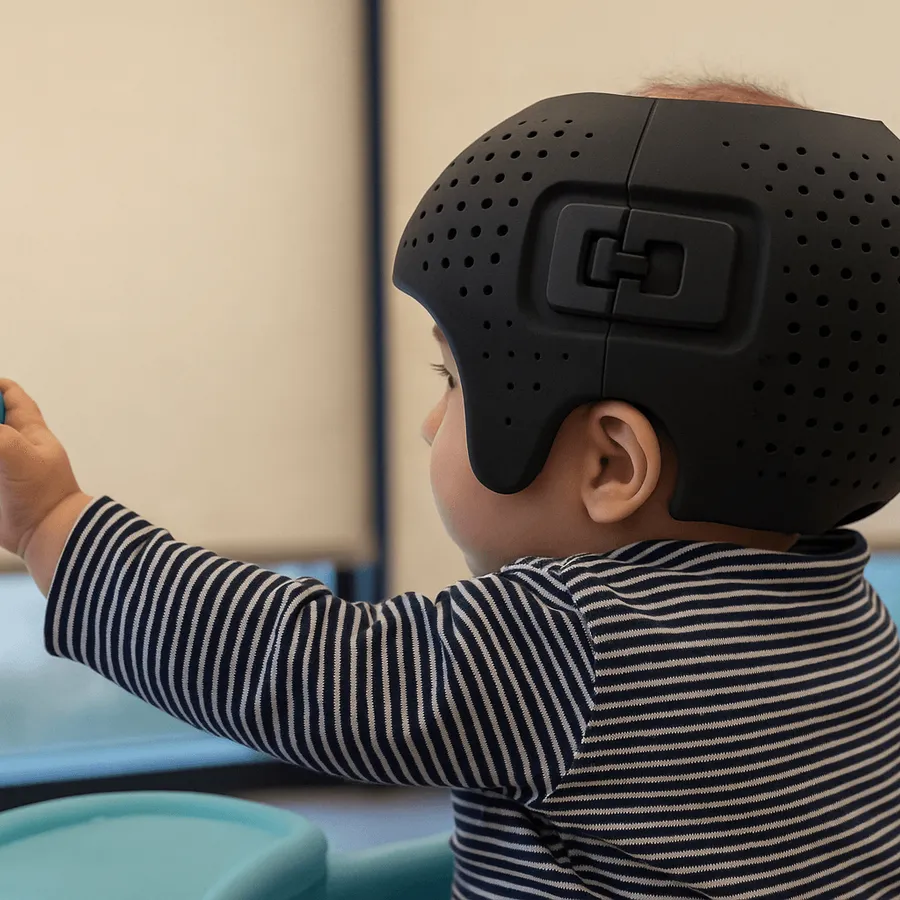
Caring for two babies is already demanding, but helmet wear itself usually does not add a large extra load once babies adapt. Helmets can even offer some protection if babies bump heads while playing.
Positional plagiocephaly is usually not genetic; it is related to external pressure. Higher rates in twins mainly reflect limited space, not inherited “flat head genes.”
Your twins’ health and comfort come first. Asymmetry can reflect their prenatal journey, but it does not have to remain unchanged.
CranioWell Orthotics & Prosthetics Centers support twin families with coordinated assessment and 3D scanning. Both babies can often be measured in the same visit, quickly and without radiation.
This content is for information only and does not replace diagnosis or treatment.