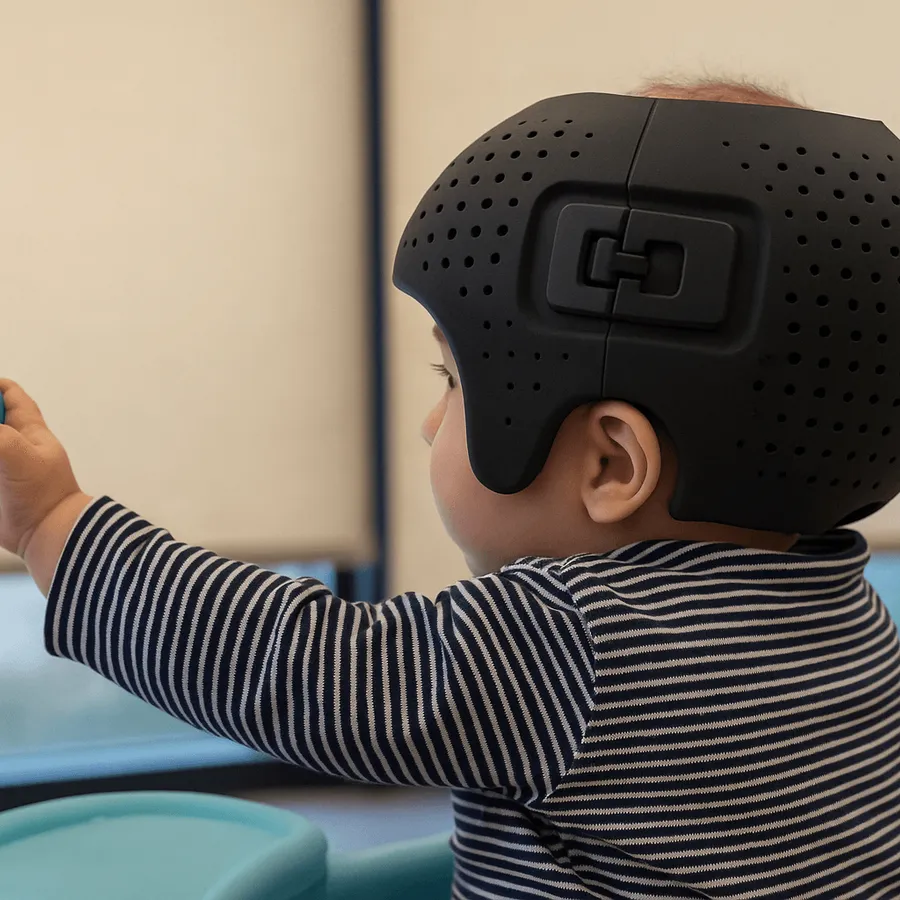
How to Check Your Baby's Head Shape at Home: A Step-by-Step Parent Guide
Parents can do a simple visual check of their baby's head shape at home. This step-by-step guide explains what to look for and when to seek professional assessment.
How to Check Your Baby's Head Shape at Home: 4-Step Parent Guide
Quick answer: You can assess your baby's head shape at home using four viewing angles: top-down (bird's eye), ear alignment, front-on facial symmetry, and side profile. These checks are most informative while the baby's hair is wet (after a bath). If you notice asymmetry, see a paediatrician or orthotist.
Has a nagging feeling about your baby's head shape crept up on you? Perhaps a flatness you noticed while bathing them, or an angle in a photo… Parental instincts are usually right. But to be certain, you need to know what to look for and how to look for it.
Without waiting for a doctor's appointment, you can pick up important clues about your baby's head shape from a simple visual check in the comfort of your own home. As specialists at CranioWell Orthopedic & Prosthetic Centers, we have prepared a 4-step check guide for parents to use at home.
Tip: Doing these checks while the baby's hair is wet (after a bath) makes the head shape much easier to see clearly.
Step 1: Bird's Eye View (From Above) — The Most Important Angle
The easiest way to identify head shape deformities (especially Plagiocephaly and Brachycephaly) is to look directly down at the baby from above.
How to do it: Sit your baby on the floor or on your lap. Stand and look straight down at the top of their head.
What to look for:
Does the head look like an "egg" or a "pear"? (Normal shape is roughly oval.)
Is one side of the back of the head flat while the other side is round?
The Parallelogram Effect: If there is asymmetry, the head shape looks like a skewed parallelogram rather than a rectangle — this is a classic plagiocephaly sign.
Step 2: Ear Alignment Check
While still looking from above, focus on the ears. Ear position is the most reliable indicator of displacement at the skull base.
How to do it: Place your index fingers on top of your baby's ears.
What to look for: Are the ears at the same level? Or is one sitting further forward than the other?
Rule: The ear on the side where flattening has occurred typically shifts forward toward the face. A visible difference in the distance between the ears is a sign of plagiocephaly.
Step 3: Facial and Forehead Asymmetry (Front-On View)
Now face the baby and focus on the face. In more advanced cases, deformities at the back of the skull can be visible at the front.
What to look for:
Forehead bulge: Is the forehead on the flattened side more prominent (bulging forward) than the other side?
Eyes: Does one eye appear smaller or sit lower or higher than the other?
Cheeks: Is one cheek fuller than the other?
Step 4: Side Profile (From the Side)
Finally, look at your baby from both the right and left profile. This angle is particularly important for detecting Brachycephaly (Flat Head) and Scaphocephaly (Long Narrow Head).
What to look for:
For Brachycephaly: When viewed from the side, does the back of the head appear to have no normal curve — almost like a vertical wall? The head looks short front-to-back.
For Scaphocephaly: Does the head appear very long front-to-back and narrow side-to-side?
Ear position: Is one ear pushed markedly further forward than the other?
What Do You Do with the Results?
If you notice any of the above signs — especially if they are worsening over time — this is your cue to:
See your paediatrician first to rule out structural conditions (craniosynostosis).
Request a 3D head scan assessment at a cranial centre. Unlike a tape measure, 3D scanning measures the full three-dimensional shape of the skull and calculates the degree of asymmetry (CVAI).