
Helmet Therapy
Head Shape Deformity in Twins: Why Is It More Common?
Why is flat head syndrome more common in twins? Intrauterine crowding, premature birth, and NICU positioning explained.
Helmet Therapy
Why is flat head syndrome more common in twins? Intrauterine crowding, premature birth, and NICU positioning explained.
Quick answer: Head shape deformity (plagiocephaly or brachycephaly) is significantly more common in twins due to intrauterine crowding, frequent premature birth, and positional constraints after delivery. Both twins can be fitted with helmets at the same appointment at CranioWell.
Statistics show that the rate of head shape deformity in twins is much higher than in singleton pregnancies. What causes this — and what can be done about it? At CranioWell Orthopedic & Prosthetic Centers, we have examined this special situation in multiple pregnancies and the solutions available.
In a singleton pregnancy, the baby has relatively ample space to move and float inside the womb. In twins or higher-order multiples, however, the space is shared — and movement becomes increasingly limited as the final months of pregnancy approach.
In medical terminology this is called "Intrauterine Constraint."
An interesting pattern we frequently see in twins is Mirror Image Plagiocephaly. Due to their intrauterine positions, one twin typically rests with the head to the right while the other is forced to turn left.
As discussed in our premature baby article, premature babies have significantly softer bones. Approximately 60% of twin pregnancies result in premature delivery.
The cramped intrauterine position affects not only the skull bones but also the neck muscles. The baby remaining for an extended period with the neck flexed or rotated can cause shortening of the SCM muscle. After birth, the baby struggles to turn the head to the other side and continues resting on the same spot. This causes existing flattening to progress. The incidence of torticollis in twins is higher than in singletons.
Caring for twins is physically demanding. While attending to one baby (feeding, nappy change), the other must wait safely — often in a bouncer or pram. These waiting periods can increase the time during which pressure is applied to the back of the head. This is not parental negligence; it is an inevitable practical reality.
Yes, this is very common. One baby may have been more constrained in the womb (for example pressing against the pelvis). Each baby's degree of involvement varies.
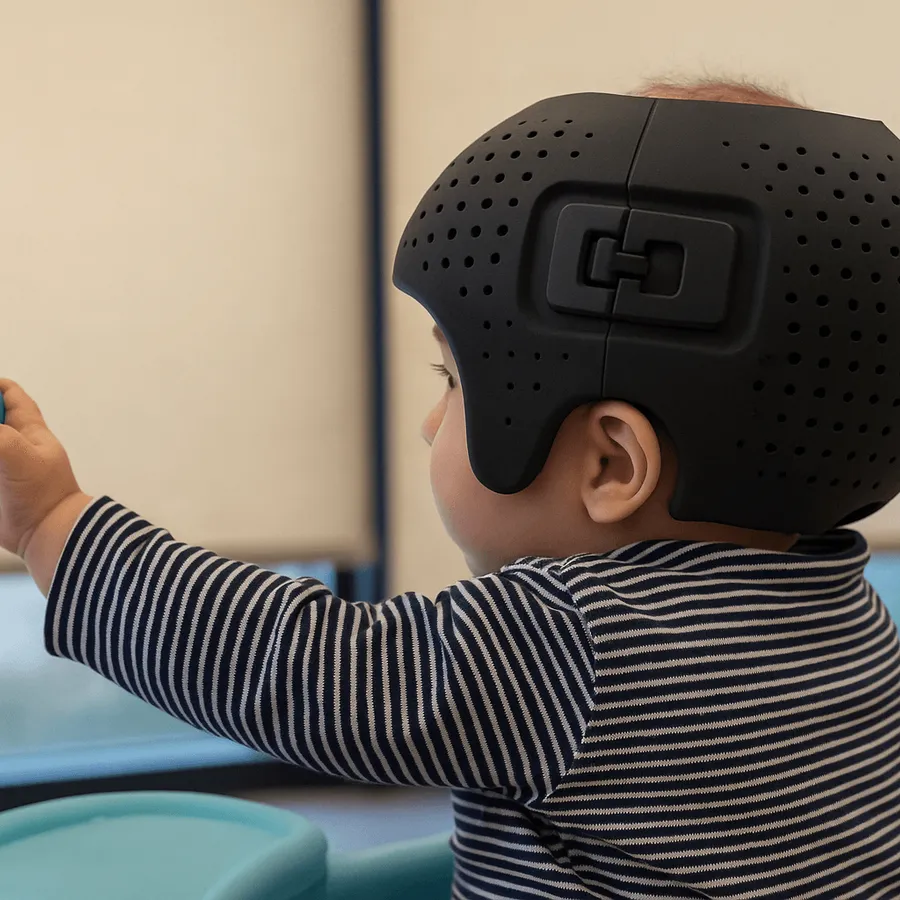
Managing two babies is challenging in itself, but helmet therapy does not add a significant extra burden. Babies adapt to their helmets very quickly. In fact, helmets act as a protective barrier, preventing babies from bumping heads against each other during crawling and play.
Head shape deformity (Plagiocephaly) is generally not genetic but positional (caused by external pressure). Its higher occurrence in twins is due to space constraints, not genetics.
At CranioWell Orthopedic & Prosthetic Centers, we stand by twin families with our specialist approach and 3D scanning technology. We can measure both babies at the same appointment, quickly and without causing distress.