
Helmet Therapy
Does Head Shape Relapse After Helmet Therapy?
The correction from baby helmet therapy is permanent. Why shape does not revert and the weaning process explained.
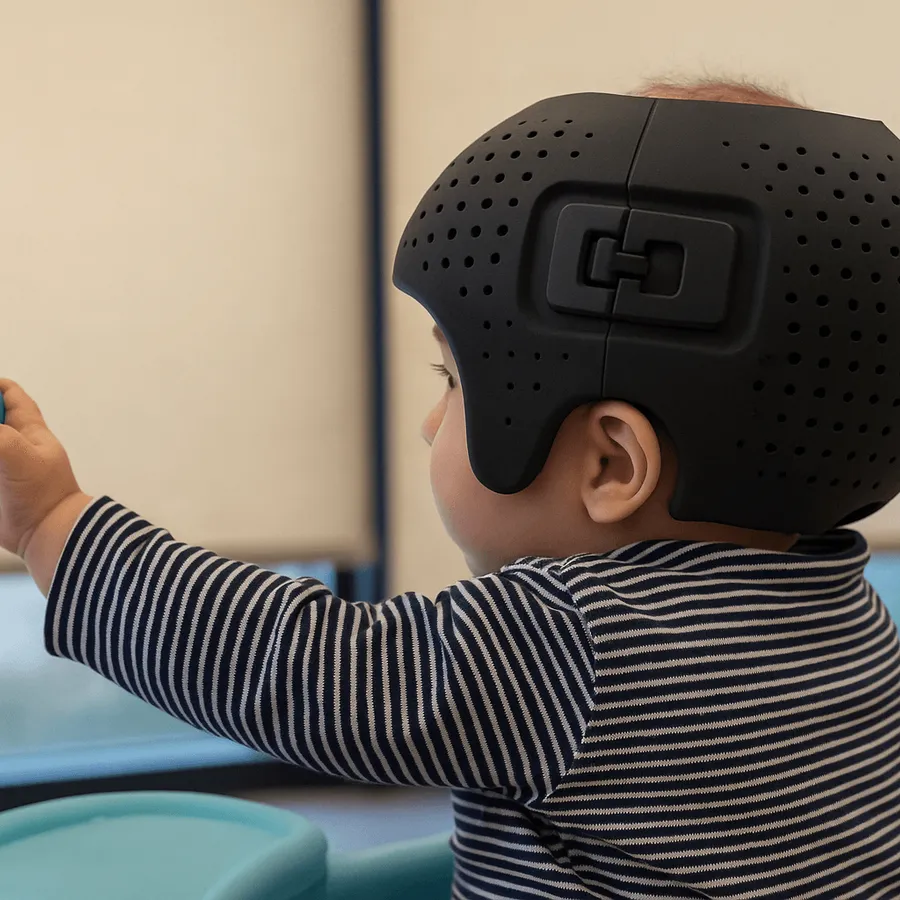
Helmet Therapy
The correction from baby helmet therapy is permanent. Why shape does not revert and the weaning process explained.
Quick answer: Yes — correction achieved with helmet therapy is permanent. Once skull bones harden (ossify) in the corrected shape, they do not revert. Unlike dental braces, what is being reshaped is bone — and once bone sets in a new form, that form becomes its permanent state.
Months of careful use, check-ups, measurements… And finally, that happy day: Graduation! Your baby's helmet therapy is complete, the skull shape has reached the target symmetry.
But parents' joy is often shadowed by a deep concern: "When the helmet comes off, will the head shape go back? Will it return to how it was?" You may be wondering whether there is a risk of relapse — the way teeth can shift back after braces are removed. At CranioWell Orthopedic & Prosthetic Centers, we give you the reassuring answer backed by biological and medical fact.
The correction achieved with helmet therapy is permanent. The skull is not like a rubber ball — it does not spring back when released. The permanence of helmet therapy is based on the process of ossification (bone hardening).
Let's recall how helmet therapy works: the helmet guides growth. Your baby grew while wearing the helmet, and the skull bones developed in their new, more rounded form.
There are two main reasons the shape does not deteriorate once treatment is complete:
Treatment started early usually finishes when the baby is around 12 months of age. At this point, skull bones are no longer as soft as modelling clay as they were at birth. The bones have mineralised, hardened, and thickened. Bone that has hardened maintains its shape unless it receives a significant impact from outside.
After treatment (from 12 months onward), the rate of head growth slows considerably. This means there is no longer rapid, aggressive growth or pressure that could re-deform the skull.
Your baby is no longer a newborn lying constantly on their back. They walk, run, and roll over during sleep. Because there is no sustained pressure on the back of the head, the risk of "positional flattening" has been eliminated.
Teeth can drift back after braces come off because teeth sit in soft tissue (gums). However, what helmet therapy reshapes is bone. Once bone takes a shape and hardens, that new form becomes its normal state.
At CranioWell, we do not abruptly stop treatment overnight. To guarantee permanence and ease the family's peace of mind, we follow a gradual weaning protocol.
Theoretically, shape reversion is almost impossible — but in medical terms, 0.1% exceptions might include:
Note: In a healthy baby with only positional deformity, the shape will not revert after completed treatment.
The result at the end of treatment (when bones have hardened) is the final outcome. Neither wearing nor not wearing a helmet afterwards will dramatically change the bone structure. However, as the hair thickens, that slight asymmetry will typically become completely invisible.
No special pillow is needed. You can transition to a standard sleep arrangement appropriate for your baby's age.
Entirely up to you! Many families keep it as a memento, decorate it, or even use it as a planter. Medically, it never needs to be worn again.
Rest easy. The gift you have given your baby through helmet therapy is not a temporary fix — it is a healthy, well-formed skull shape they will carry for life.
When graduation day arrives, put that helmet on the shelf and enjoy running your fingers through your baby's hair. As the CranioWell family, we are proud to be part of this happy ending.