
Helmet Therapy

Plagiocephaly and Helmet Therapy in Babies | CranioWell

Causes and signs of infant plagiocephaly, how cranial helmet therapy works, who it suits, and care tips during treatment at CranioWell Orthotics & Prosthetics Centers.
Plagiocephaly and Helmet Therapy in Babies | CranioWell
Helmet Therapy

Plagiocephaly and Helmet Therapy in Babies: Causes, Signs, and Solutions

Infant head shape differences worry many parents. Plagiocephaly—often called flat head syndrome—means one side of the skull is flatter or more compressed than the other. Early recognition and appropriate care can help. Below is a practical overview of plagiocephaly and cranial helmet therapy.

What Is Plagiocephaly?

Plagiocephaly means “oblique head.” It is the most common type of positional cranial deformity (PCD). Flattening appears on the back or side of the head while skull bones are still soft and flexible, so growth can be influenced by pressure.

Other common patterns include:

  • Brachycephaly (short head): Short front-to-back length and increased width, often with broad occipital flattening.
  • Scaphocephaly (long head): Narrow side-to-side width and increased front-to-back length.

These patterns may appear alone or together with plagiocephaly, depending on position, development, and other factors.

Why Does Plagiocephaly Happen? Risk Factors

Several factors can contribute:

  • Positional pressure: Long periods in one position keep pressure on one skull area. Back sleeping recommendations have coincided with more positional flat spots—while remaining essential for safe sleep.
  • Prenatal factors: Fetal position, low amniotic fluid, or multiple pregnancy can affect early head shape.
  • Birth-related pressure: Difficult deliveries may contribute.
  • Torticollis: Neck tightness keeps the head turned one way and flattens that contact side.
  • Prematurity: Softer bones and longer periods lying in one position in intensive care can increase risk.
  • Meconium aspiration care: Prone positioning used in some treatments can influence head shape.

Signs of Plagiocephaly

Findings are usually noticed in the first weeks or months:

  • Flattening: Clear flat area on the back or side of the head.
  • Asymmetry: One side more compressed or more prominent than the other.
  • Ear position difference: One ear may sit farther forward or back.
  • Forehead change: The forehead on the flatter side may look more prominent.
  • Facial asymmetry: In more severe cases, facial balance can be affected.

If you notice these signs, seek professional evaluation. Earlier care generally supports better remodeling.

What Is Helmet Therapy and How Does It Work?

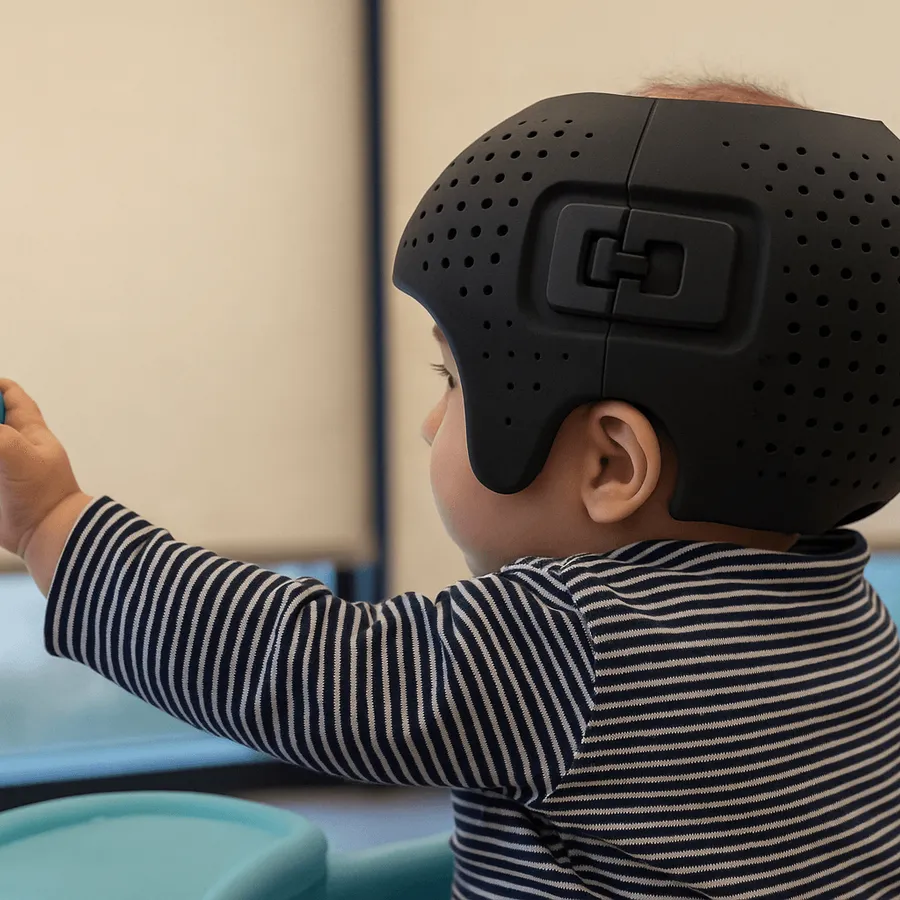
Helmet therapy uses a custom medical cranial orthosis to guide growth in moderate to severe deformities. It encourages expansion in flatter areas while controlling growth where the head is already full. Fitting and follow-up for CranioWell helmets take place only at CranioWell Orthotics & Prosthetics Centers.

Typical steps:

ol>
  • Evaluation and scanning: A clinician assesses head shape. When appropriate, precise measurements are taken with 3D scanning at a CranioWell center.
  • Custom design: A helmet matched to the baby’s head is produced from the scan data, often with 3D manufacturing methods.
  • Fitting and follow-up: Wear is often 20–23 hours per day. Periodic visits adjust fit as the baby grows; a replacement may be needed in some cases.
  • Helmet therapy is often most useful between about 4 and 9 months, when growth is fastest. Earlier or later starts may still be considered when clinically appropriate.

    Who Is Helmet Therapy For?

    Helmet therapy is often considered when:

    • Moderate to severe shape differences: Mild flattening is usually managed first with repositioning. Helmets are considered when progress is limited or asymmetry is already clear.
    • Age range: About 4–9 months is a common window; suitable candidates may range from roughly 3 to 18 months. Earlier starts within the growth window tend to respond more readily.
    • Otherwise healthy infants: Helmets are for positional deformities, not as a substitute for surgery when craniosynostosis requires operative care.

    Start timing is decided with clinical assessment of age, severity, and growth rate. Because helmets guide growth, faster growth periods usually allow clearer change—so timely evaluation matters.

    Care During Helmet Therapy

    Treatment needs patience and regular follow-up. Parents should keep in mind:

    • Cleaning: Clean the inner surface regularly to protect skin hygiene.
    • Skin checks: Watch contact areas for redness, irritation, or sores; use skin-care products only as advised.
    • Fit: Correct seating and pressure points matter for effectiveness—do not skip center follow-ups.
    • Wear schedule: Near-continuous wear (often about 23 hours/day) supports progress; remove only for short care periods such as bathing.
    • General health: Good nutrition and overall development support the treatment period.

    Helmet Therapy vs Surgery: Comparison

    Feature Helmet therapy (cranial orthosis) Surgical methods
    Role Often used for moderate–severe positional deformities. Usually for severe structural problems such as craniosynostosis.
    Approach Non-surgical / non-invasive. Operative; higher inherent risks.
    Course Continues while the helmet is worn, often several months. Postoperative recovery is longer and more complex.
    Risks Skin irritation, sweating, and similar local effects. Infection, bleeding, anesthesia risks, and other surgical risks.
    Cost Often lower than surgery for positional cases. Surgical costs are typically higher.
    Wear / process Worn most of the day (20–23 hours). One-time procedure followed by recovery care.
    Suitability Often infants about 4–18 months with positional deformity. Age varies; especially relevant for craniosynostosis.
    Infant Head Shape Differences: Early Care, Prevention, and CranioWell HKM Pro Helmet TherapyHelmet Therapy: The Critical Role of Families in Your Baby’s Healthy Head DevelopmentHelmet Therapy Costs and Insurance Coverage: Parent GuideHelmet Therapy: A Family Guide to Healthy Head Development