
Helmet Therapy
Head Circumference Measurement in Babies: Growth and Ideal Ranges
Why head circumference tracking matters, how to measure correctly, what percentiles mean, and why tape alone cannot diagnose flat head or asymmetry.
Helmet Therapy
Why head circumference tracking matters, how to measure correctly, what percentiles mean, and why tape alone cannot diagnose flat head or asymmetry.
From the moment you first hold your baby, every millimeter of growth feels precious. Along with height and weight at monthly visits, clinicians also measure head circumference with a tape.
Have you ever wondered what that tape is really checking? Only head size—or the remarkable development inside? At CranioWell Orthotics & Prosthetics Center, we review why head circumference matters and how it relates to head shape concerns such as flat head.
The main purpose of tracking infant head circumference is to monitor brain growth indirectly. At birth, the brain is about 25% of adult size. In the first 2 years it grows rapidly, and skull bones expand to match.
Head circumference measurement is precise work. Parents can measure at home for a rough idea, but clinician measurement remains the standard for decisions.
Correct technique:
This path captures the widest head circumference.
Your clinician plots the result on a percentile chart.
Consistency matters most: Your baby’s head may always track at the 90th percentile (larger than peers). If that curve is stable, it is often a genetic trait (larger-headed parents). Sudden jumps from the 50th to the 90th—or drops toward the 10th—are warning signs.
Here is where parents are most often misled. Head shape differences can make tape circumference misleading.
For example, in brachycephaly (flat head syndrome):
Therefore, tape measurement alone is not enough to detect head shape differences. When shape is a concern, 3D scanning or cross measurements (including CVAI) are needed.
These terms often frighten parents when they appear on reports:
Your pediatrician may refer you to a specialist or a center such as CranioWell when:
The folk belief that “big-headed children are smarter” is common, but there is no proven direct link between circumference size and intelligence. Structural and functional brain health matter more.
Tape angle, tightness, and placement can change results by 1–2 cm. Consistent measurement by the same clinician is best for tracking.
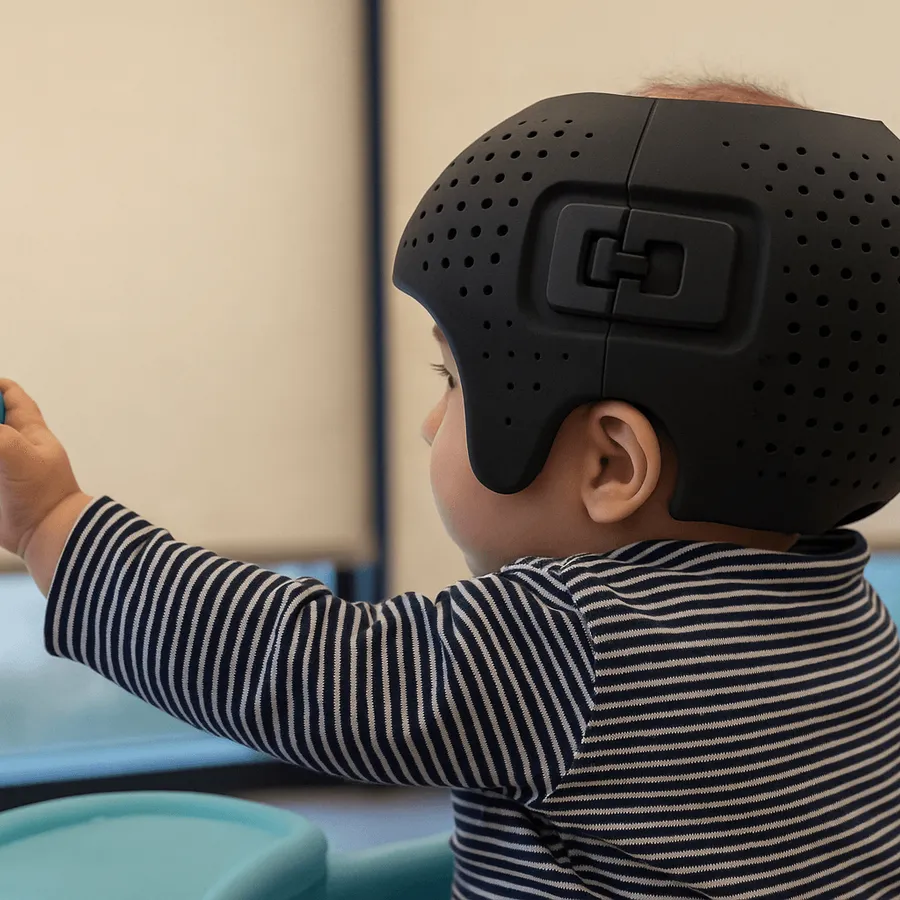
No. Helmet therapy (cranial orthosis) does not compress the head smaller. Circumference continues to grow while the helmet guides growth into flatter areas. After care, circumference follows the baby’s natural growth curve. Helmets are fitted at CranioWell Orthotics & Prosthetics Centers.
Head circumference is an important part of your baby’s health picture. Remember: “Normal measurement” does not always mean “normal shape.”
Even if percentiles look fine, visible flattening, unevenness, or widening deserves clinical review. At CranioWell Orthotics & Prosthetics Center, 3D scanning analyzes three-dimensional shape—not only circumference—so you can get clearer information.
This content is for information only and does not replace medical diagnosis or treatment.