
Helmet Therapy
Flat Head Syndrome in Babies and Helmet Therapy
Why debates on infant helmet therapy continue, when CranioWell HKM Pro may help for plagiocephaly and brachycephaly, and what timing windows matter.
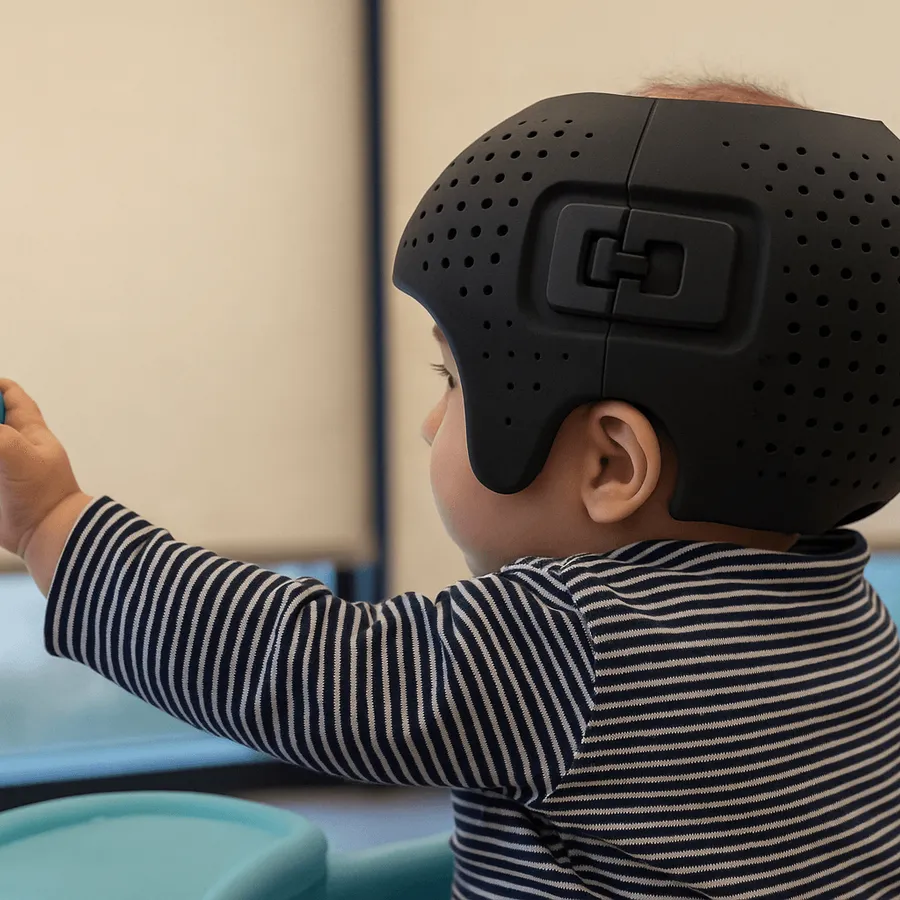
Helmet Therapy
Why debates on infant helmet therapy continue, when CranioWell HKM Pro may help for plagiocephaly and brachycephaly, and what timing windows matter.
Treatment of infant flat head differences (positional plagiocephaly and brachycephaly) has long been debated in Türkiye and internationally.
Some experts frame it as only a cosmetic issue; others—including our team—see it as a developmental shape concern that benefits from earlier guidance.
The debate became more visible after the 1990s Back to Sleep campaign increased back sleeping and, with it, positional head shape cases.
Studies report that a substantial share of newborns show mild to noticeable asymmetry; some series describe higher rates.
Over the last 30 years, the frequency of head shape differences has risen markedly.
Back sleeping is correct for sleep safety, yet continuous contact on the same point can accelerate occipital flattening (brachycephaly) and lateral asymmetry (plagiocephaly).
At CranioWell Orthotics & Prosthetics Application Center, we see that positional deformation often develops during active growth, especially between about 4 and 8 months of age.
In many babies, improvement is possible in the first 3 months with repositioning and physiotherapy.
For clearer deformities or later presentations, those approaches alone may not be enough.
This is where the CranioWell HKM Pro helmet may be considered.
Helmet therapy guides natural head growth so the skull can expand more symmetrically.
It is not forceful compression; it is a dynamic guidance method that uses active growth. The HKM Pro helmet is fitted only at CranioWell Orthotics & Prosthetics Centers.
Skull growth potential begins to decline after about month 4.
For that reason, a commonly discussed start window for CranioWell helmet therapy is about 4–7 months.
After 12 months, improvement potential is more limited; after about 14 months, as bones fuse further, meaningful change becomes harder.
| Age Range | Care Approach | Response Potential |
|---|---|---|
| 0–4 months | Repositioning and exercises are usually preferred | Higher |
| 4–8 months | CranioWell HKM Pro helmet therapy often most responsive | Highest |
| 8–12 months | Helmet therapy may still be used; growth slows | Moderate |
| 12–14 months | Treatment may start, with more limited change expected | Lower |
| 14+ months | Options outside surgery are usually limited | Often not suitable |
Comparative studies in the international literature report that repositioning alone may achieve substantial improvement in many milder cases, while helmet therapy pathways often show higher rates of more complete correction in selected moderate-to-advanced cases. Exact percentages vary by study design, severity, and protocol—so individual counseling matters more than a single headline number.
The CranioWell system differs from many older helmet designs in that it:
Some limited studies around 2014 argued helmet therapy was ineffective.
Many of those studies, however:
CranioWell HKM Pro is a newer-generation device built with medical 3D modeling, physiological pressure management, and a dynamic ventilation system. Older datasets do not fully reflect today’s CranioWell clinical pathways.
Not only visual.
Head shape differences can relate not just to appearance but also to balance, visual alignment, jaw development, and sometimes early motor skills.
Moving closer to a more typical head form can support more symmetric development of these systems.
CranioWell’s approach aims to be corrective for shape and supportive of broader developmental balance—not a guarantee of any specific outcome.
We support early assessment and care for infant head shape differences with the EUDAMED- and ÜTS-registered CranioWell HKM Pro helmet, a locally manufactured medical device.
Care plans are individualized to each baby’s anatomy, informed by clinical data, and coordinated with physician oversight—while helmet fitting and adjustments are performed at CranioWell Orthotics & Prosthetics Centers.