
Helmet Therapy
What Is 3D Head Scanning? Why a Measuring Tape Alone Is Not Enough
3D head scanning creates a precise digital model of your baby’s skull shape—safer than X-ray imaging and more objective than tape-only measurements for asymmetry.
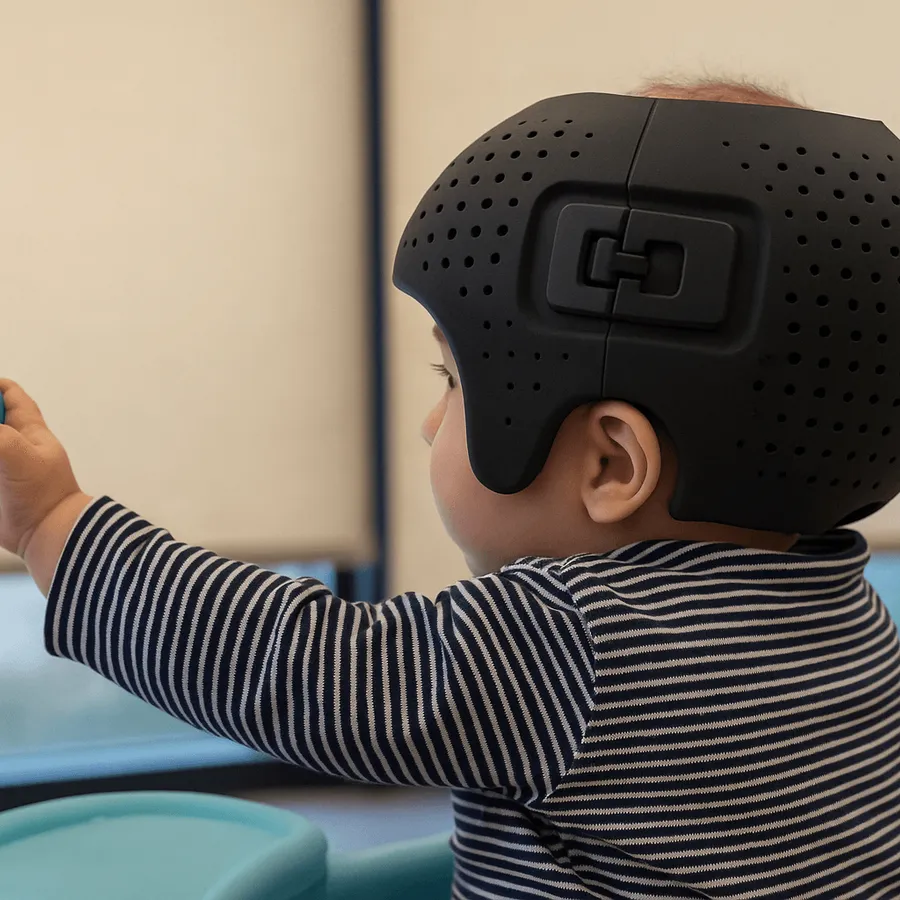
Helmet Therapy
3D head scanning creates a precise digital model of your baby’s skull shape—safer than X-ray imaging and more objective than tape-only measurements for asymmetry.
You know that head circumference is measured with a tape at well-baby visits. Yet when you see different clinicians about a suspected head shape concern (flat head syndrome), you may hear different impressions—one saying “mild,” another “moderate.” That subjectivity confuses parents and makes treatment decisions harder.
This is where technology helps. At CranioWell Orthotics & Prosthetics Center, we use 3D head scanning—widely regarded as a high standard for assessment and follow-up—rather than relying only on “eyeballing” or tape measurement. So what is this technology, and why does it go further than classic methods?
3D head scanning is an advanced imaging method that creates a three-dimensional digital copy of your baby’s head shape. Devices are moved around the head (or used in a fixed system) and collect thousands of data points within seconds.
The result on screen is a millimeter-level “digital twin” of your baby’s head that can be rotated and reviewed from every angle.
This is parents’ biggest concern. Clearly: No—3D scanning devices used for this purpose do not emit ionizing radiation.
A tape is useful for head circumference (size) but limited for analyzing head shape. Here are the differences:
A square and a circle can share the same perimeter (for example, both 40 cm). A tape only reports “40 cm”; it does not tell you whether the shape is square or round.
Tape measurements can vary from person to person.
An international measure used for the severity of cranial asymmetry is CVAI (Cranial Vault Asymmetry Index).
Babies do not sit still—we know. The technologies we use are designed with infant movement in mind.
After scanning, you receive a detailed report that typically includes:
Based on these concrete findings, whether helmet therapy is appropriate can be discussed more objectively. Guesswork like “I think it will improve” gives way to “here is what the data show.”
No. Unlike some CT/MRI settings, strict immobility is not required. Scanning can often be done while the baby is awake and even playing.
The devices we use are designed with eye-safety considerations and are generally less bothersome than a camera flash. Still, we redirect the baby’s attention so they are less likely to stare directly at the light.
Yes. For babies in helmet therapy, scanning is usually repeated at regular intervals (often every 2–3 weeks) to track change and guide helmet adjustments at CranioWell Orthotics & Prosthetics Centers.
Your baby’s care is too important to leave to estimates alone. Tape measurements give a general idea, but careful diagnosis and follow-up of head shape concerns benefit from technology.
At CranioWell Orthotics & Prosthetics Center, you can obtain a 3D head analysis and learn the degree of asymmetry with clear numbers and visuals.
This content is for information only and does not replace medical diagnosis or treatment.