
Helmet Therapy
Bebeklerde Gözle Muayene: Evde Ebeveyn Kontrolü Nasıl Yapılır?
Step-by-step guide for parents to check baby head shape at home: bird's eye view, ear alignment, facial symmetry, and side profile checks.
Helmet Therapy
Step-by-step guide for parents to check baby head shape at home: bird's eye view, ear alignment, facial symmetry, and side profile checks.
Quick answer: You can assess your baby's head shape at home using four viewing angles: top-down (bird's eye), ear alignment, front-on facial symmetry, and side profile. These checks are most informative while the baby's hair is wet (after a bath). If you notice asymmetry, see a paediatrician or orthotist.
Has a nagging feeling about your baby's head shape crept up on you? Perhaps a flatness you noticed while bathing them, or an angle in a photo… Parental instincts are usually right. But to be certain, you need to know what to look for and how to look for it.
Without waiting for a doctor's appointment, you can pick up important clues about your baby's head shape from a simple visual check in the comfort of your own home. As specialists at CranioWell Orthopedic & Prosthetic Centers, we have prepared a 4-step check guide for parents to use at home.
Tip: Doing these checks while the baby's hair is wet (after a bath) makes the head shape much easier to see clearly.
The easiest way to identify head shape deformities (especially Plagiocephaly and Brachycephaly) is to look directly down at the baby from above.
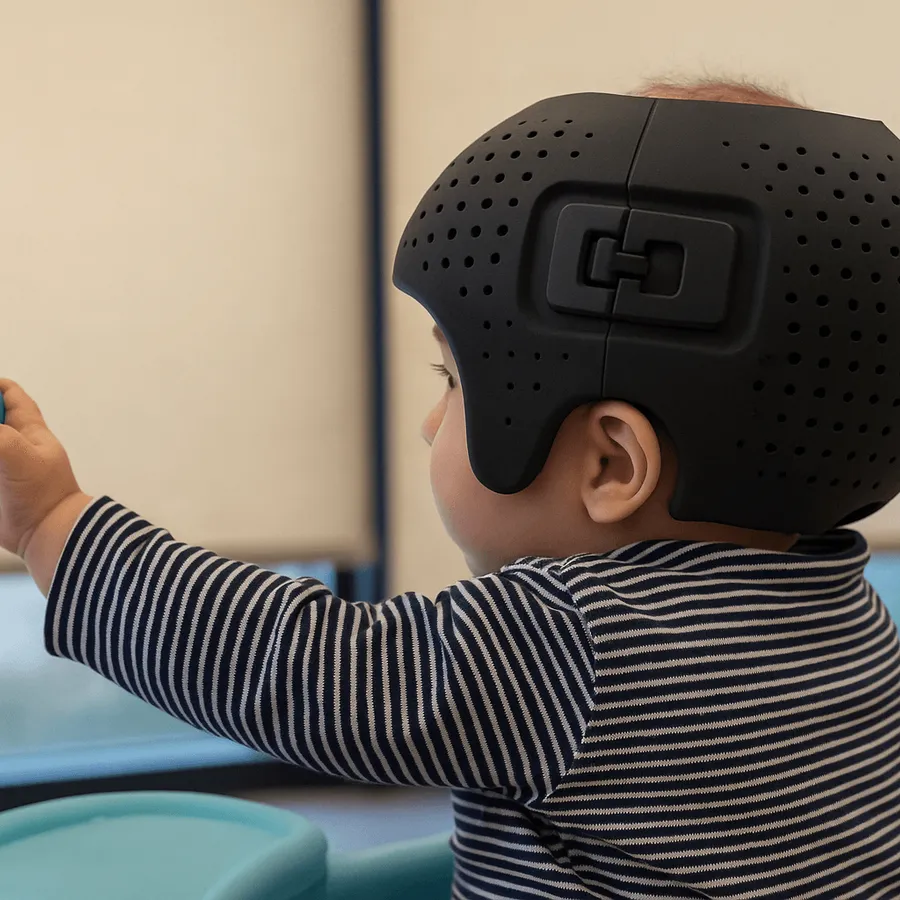
While still looking from above, focus on the ears. Ear position is the most reliable indicator of displacement at the skull base.
Now face the baby and focus on the face. In more advanced cases, deformities at the back of the skull can be visible at the front.
Finally, look at your baby from both the right and left profile. This angle is particularly important for detecting Brachycephaly (Flat Head) and Scaphocephaly (Long Narrow Head).
If you notice any of the above signs — especially if they are worsening over time — this is your cue to:
At CranioWell, assessments are carried out using 3D scanning — non-contact, painless, and completed in seconds. Request a preliminary assessment here.
Related: Baby Head Shape Types, 3D Scan vs Tape Measure, What Is CVAI?