
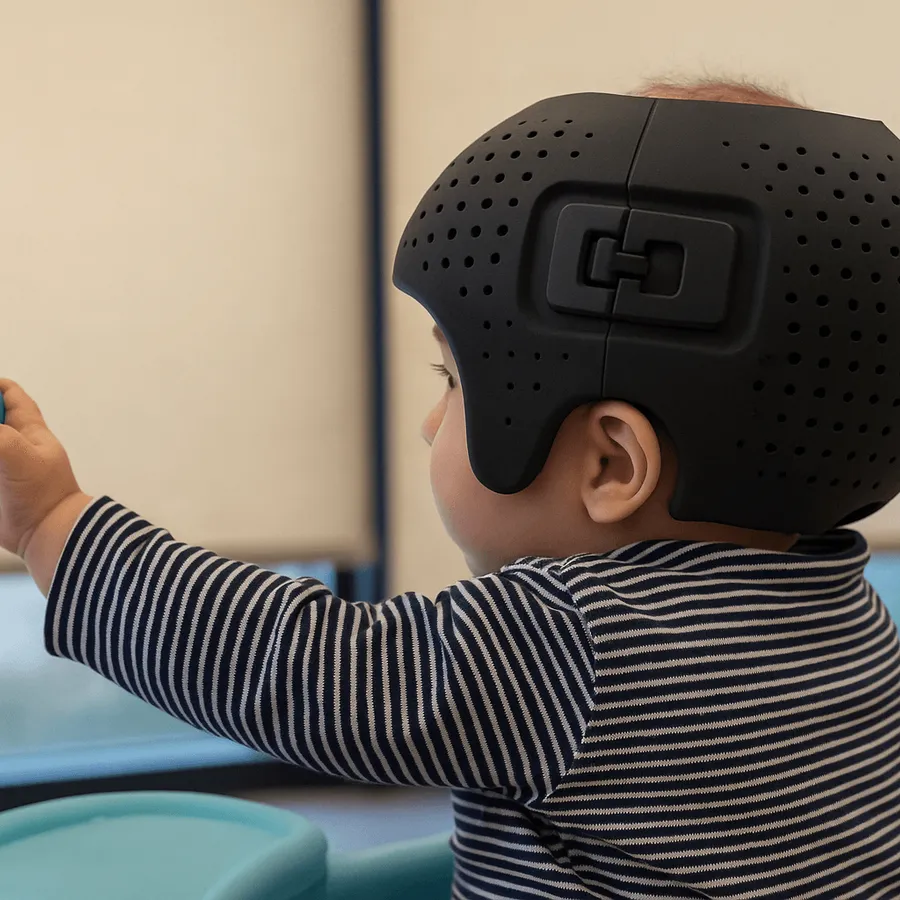
In brief: Scaphocephaly is a condition in which a baby's head appears long from front to back and narrow from side to side. It has two different causes, and the treatments are distinct.
- Sagittal synostosis (craniosynostosis): Premature closure of the sagittal suture at the top of the head. Does not resolve on its own; treatment is surgical.
- Deformational (positional) scaphocephaly: Develops in premature babies in particular as a result of prolonged side-lying in intensive care. The sutures are open; it may improve with positional changes, and a helmet is considered in significant cases.
- Who makes the distinction? Medical examination and imaging where necessary clarifies which type is present.
What is scaphocephaly?
Scaphocephaly refers to a head shape that appears long from front to back and narrow from side to side. The word comes from Greek: skapho (boat) + cephali (head). The name was given because the head shape resembles a boat.
Head shape is often one of the first things families notice. This appearance — described as a "long, narrow head" — can result from two different causes:
- Sagittal synostosis (craniosynostosis): Premature closure of the sagittal suture at the top of the head. When the suture closes, the head cannot expand sideways; it elongates front to back in parallel with brain growth. This type does not resolve on its own.
- Deformational scaphocephaly: Positional shaping in premature babies from prolonged side-lying in intensive care. The sutures are open; early intervention can allow correction.

What are the signs of scaphocephaly?
- Head appears long and narrow when viewed from above
- The forehead and back of the head protrude outwards
- A more pointed profile than usual when the head is viewed from the side
- In sagittal synostosis: a firm ridge or prominence running forward along the top of the head
What is the difference between sagittal synostosis and deformational scaphocephaly?
- Sagittal synostosis: The suture is closed. A firm ridge can be felt along the very centre of the head when viewed from above. The head shape continues to worsen over time. Treatment is surgical.
- Deformational scaphocephaly: The suture is open. Positional change, variety in sleeping positions, and tummy time can largely correct it in the first months. A helmet may be considered in significant cases.
A paediatric or neurosurgical examination is essential to make the distinction.
How is scaphocephaly treated?
- Deformational scaphocephaly: Positional change, tummy time, and — in the early period — a cranial reshaping helmet (HKM Pro) are considered.
- Sagittal synostosis: Treatment is surgical. Assessment is carried out by a neurosurgery or plastic surgery specialist. A helmet is used after some operations.
For a helmet assessment, you can submit a pre-assessment application.
Frequently Asked Questions
- Does scaphocephaly resolve on its own?
- Deformational scaphocephaly may partly improve in the early period with positional change. Sagittal synostosis does not resolve; it requires surgery.
- When is scaphocephaly noticed?
- It is most often noticed shortly after birth or during the first weeks. It may also present in premature babies after intensive care.
- Is a helmet effective in scaphocephaly?
- In deformational scaphocephaly, if the sutures are open and the baby is 3–6 months old, helmet reshaping can be effective. In sagittal synostosis, a helmet does not replace surgery.