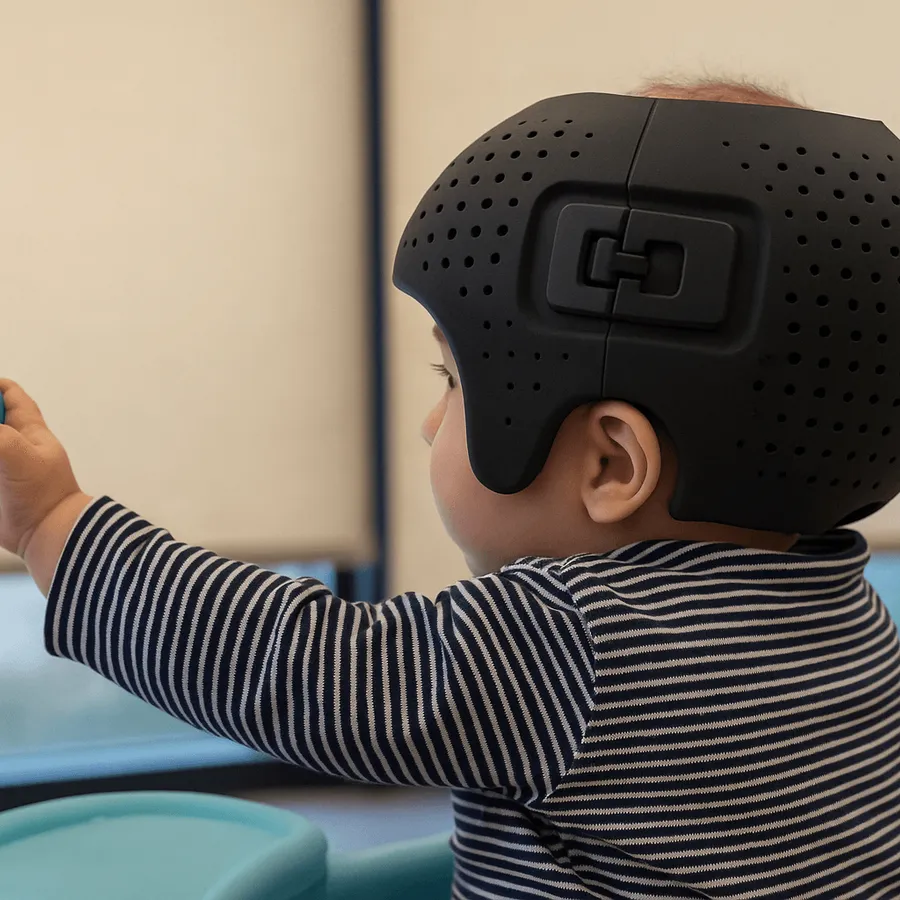
How deformational plagiocephaly is recognized and managed—repositioning, physiotherapy for torticollis, and CranioWell HKM Pro helmet therapy at Orthotics & Prosthetics Centers.
Plagiocephaly treatment in babies works best when flattening on the back or side of the head is noticed early and managed appropriately. CranioWell HKM Pro is a 3D scan–based, UTS-registered, locally manufactured medical option for suitable cases.
What Is Plagiocephaly and How Is It Noticed?
Parents are often the first to see that one side of the head is flatter or that one part of the forehead looks slightly more prominent. This is medically called deformational plagiocephaly. It is usually not dangerous, but over time it can affect head symmetry and facial proportions.
Clinical evaluation is typically based on physical examination. In most cases MRI or CT is not required. When helmet therapy is considered, assessment and 3D scanning are performed at CranioWell Orthotics & Prosthetics Centers.
Signs of Plagiocephaly
Flattening on the back or one side of the head
Mild forehead prominence or asymmetry
Noticeable shift in ear alignment
Mild imbalance in eye level
Note: These findings are often cosmetic at first, but the difference can become more noticeable as the baby grows.
How Is Plagiocephaly Treated?
1. Positional therapy (first 3 months)
Treatment often begins with position changes.
Place interesting toys or light sources to encourage turning toward different directions.
Provide supervised tummy time during daytime awake periods.
Do not keep the sleep head position fixed to one side only.
2. Physiotherapy (if torticollis is present)
Some babies also have torticollis (short or tight neck muscle). In that case, neck stretching exercises should be done with physiotherapy guidance.
3. CranioWell HKM Pro helmet therapy (about 4–7 months)
If repositioning is not enough, CranioWell HKM Pro helmet therapy may be used. This custom orthosis system:
Guides head growth toward better symmetry,
Uses a breathable structure for longer wear comfort,
Is individually manufactured from a 3D scan for close fit.
Treatment usually requires about 23 hours of wear per day for an average of 3–5 months. Helmets are applied only at CranioWell Orthotics & Prosthetics Centers.
CranioWell Treatment Process
Stage
Time
Description
1. Initial visit
30 min
Head scan and measurements.
2. Custom design
5–7 days
3D modeling and manufacturing.
3. First fitting
Week 1
Helmet applied; parents trained.
4. Follow-ups
Every 3 weeks
Progress reviewed and adjustments made.
Common Mistakes in Plagiocephaly Care
Starting treatment after 12 months
Not wearing the helmet enough hours
Keeping sleep head position fixed to one side
Trying unverified “home correction” methods from the internet
CranioWell Orthotics & Prosthetics Application Centers create an individualized plan for each patient to help avoid these pitfalls.
Is Surgery Needed?
No. Positional plagiocephaly treatment does not require surgery. Only in selected advanced cases after about 14 months—once bones are less malleable—cosmetic surgery might be discussed separately.
Tips for Parents
When noticed early, improvement without a helmet is sometimes possible.
If a helmet is needed, consistent wear matters.
Coordinate care with your pediatrician.
Stay in regular contact with the CranioWell team.
UTS- and EUDAMED-Registered Products
CranioWell HKM Pro is registered in Turkiye’s UTS system and in Europe’s EUDAMED database. This supports conformity with medical device registration requirements.