
Helmet Therapy
Is Helmet Therapy Possible After Age 1? What Results Can You Expect?
Helmet therapy after 12 months is still possible in many cases, with slower growth, longer treatment, and realistic expectations up to about 18 months.
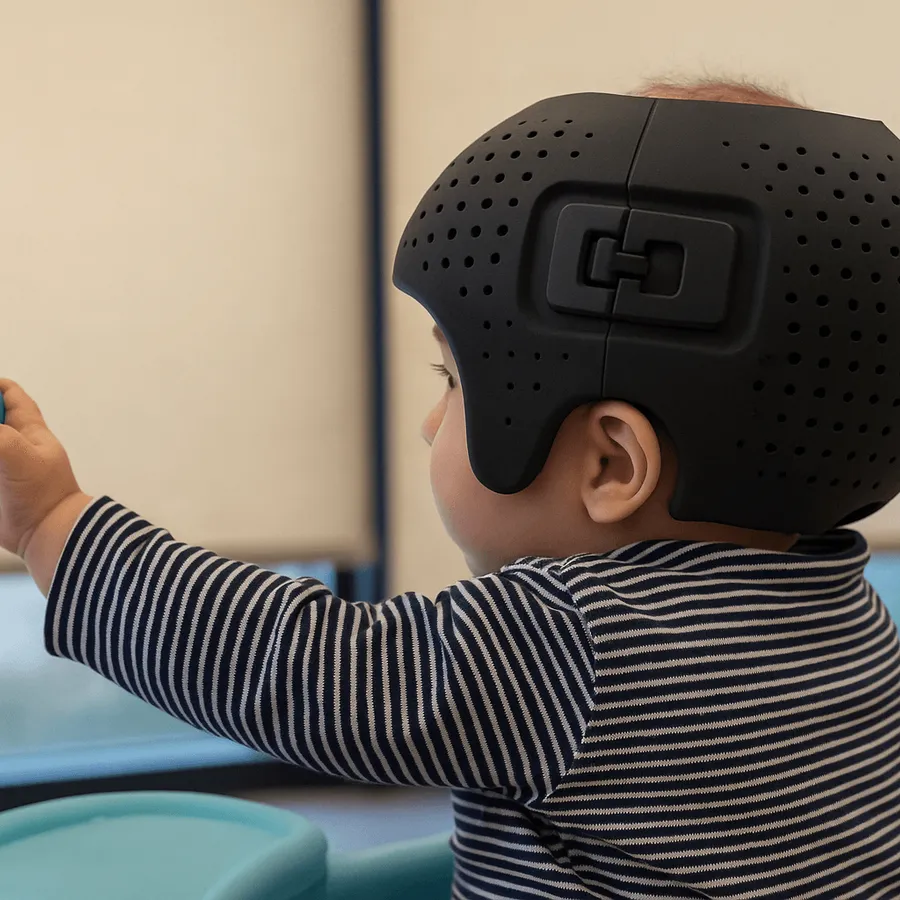
Helmet Therapy
Helmet therapy after 12 months is still possible in many cases, with slower growth, longer treatment, and realistic expectations up to about 18 months.
In the rush of parenting, months fly by. Sometimes by following “it will improve with time” advice, and sometimes without noticing, you may already have celebrated your baby’s first birthday. Yet while blowing out those candles, one question often remains: “The flat spot on my baby’s head hasn’t gone away—are we too late?”
Online information often claims “if it wasn’t done in the first 6 months, it’s over.” That is not entirely accurate. As CranioWell Orthotics & Prosthetics Center, we note that treatment options can continue for babies past 12 months, though the rules of the process change.
The short answer: Yes, helmet therapy can still be possible after age 1. The longer answer includes important caveats and realistic expectations.
Helmet therapy (cranial orthosis) uses the growth potential of the skull bones. At 1 year of age, a baby’s brain and skull are still growing—just more slowly. Where there is growth, guided reshaping (treatment) can still be possible.
Treatment for a 4-month-old and a 14-month-old does not progress at the same pace. Three main differences separate later treatment from the earlier window:
In the first months, head circumference grows millimeter by millimeter each week; after age 1 that pace slows. Because the “growth drive” the helmet needs to reshape the skull is reduced, treatment often takes longer.
As your baby starts walking, the bones harden and thicken. The fontanelle tends toward closure. Reshaping a firmer structure is harder than reshaping a soft one. For that reason, promising full symmetry is not realistic. The goal shifts from “perfect” toward meaningful, visible improvement within what growth still allows.
A 1-year-old is no longer only a lying infant; they walk, run, resist, and may try to remove the helmet. In this period, parental patience and wear discipline (the about 23 hours/day rule) are decisive for how well treatment goes.
In medical literature and in clinical practice, the upper age limit for helmet therapy is generally around 18 months.
Why 18 months?
So if your baby is 17–18 months old, we may honestly say that helmet wear may not produce enough change to justify the effort. The final decision always depends on 3D scan data and the status of the bone structure.
When a 13–14-month-old baby comes to us, our approach is:
Children this age are more socially aware. In the first days they may find the helmet strange or look surprised in the mirror. Children usually adapt well and often treat the helmet as part of their body or like a “hat.” A positive parental attitude (making it playful) matters a great deal.
After age 1, bones are firmer, so an existing flat spot or asymmetry that is not treated often becomes lasting; the chance that it “will improve as they grow” is much lower. Hair may camouflage asymmetry, but the bone shape remains.
No. The helmet principle does not change. Compression is not used. Because growth is slower, filling the designed spaces inside the helmet simply takes more time.
If your baby is between 12 and 18 months and head shape still concerns you, not everything is over. You may have missed the fastest window, but options can still remain.
Stop blaming yourself and take the next step. At CranioWell Orthotics & Prosthetics Center, a detailed analysis can help us discuss transparently how much progress may still be possible.
This content is for information only and does not replace medical diagnosis or treatment.